
How an AI chatbot to reduce customer service costs

Written By : Shantilal Matariya

Published on : June 24, 2025

5 min read


Customer support has become a mission-critical function for startups looking to scale rapidly without compromising user experience.
However, maintaining a 24/7 support operation across time zones, languages, and channels can put immense pressure on headcount and budget.
For tech-aware startup founders and CTOs, the solution lies in adopting AI-powered chatbots — tools that are no longer just digital assistants but intelligent, cost-reducing, CX-enhancing engines.
In this post, we’ll break down exactly how an AI chatbot to reduce customer service costs by 30%-40%, with data-backed insights, real-world use cases, and strategic guidance tailored to startup leaders like you.
Understanding The Real Cost of Customer Support
Before diving into AI’s customer service chatbot cost-saving impact, let’s decode what actually makes customer support expensive:
1. Labour Costs
Hiring, onboarding, and training support reps — especially for 24/7 coverage or multilingual support — is one of the biggest cost drivers.
2. Scalability Challenges
As user bases grow, ticket volume increases linearly (or faster), but hiring can’t always keep up. Each additional rep adds recurring cost, without guaranteeing efficiency.
3. Tooling & Tech Stack
Support teams often require multiple platforms: CRM, helpdesk software, knowledge bases, ticketing tools — each with associated costs and integration overhead.
4. Customer Experience Tradeoffs
Delays or poor responses increase churn, drive higher acquisition costs, and hurt brand equity — all costly in the long term.
These factors aren’t just line items — they affect growth velocity. That’s where chatbots in customer service prove transformational.
How AI Chatbots Reduce Support Costs
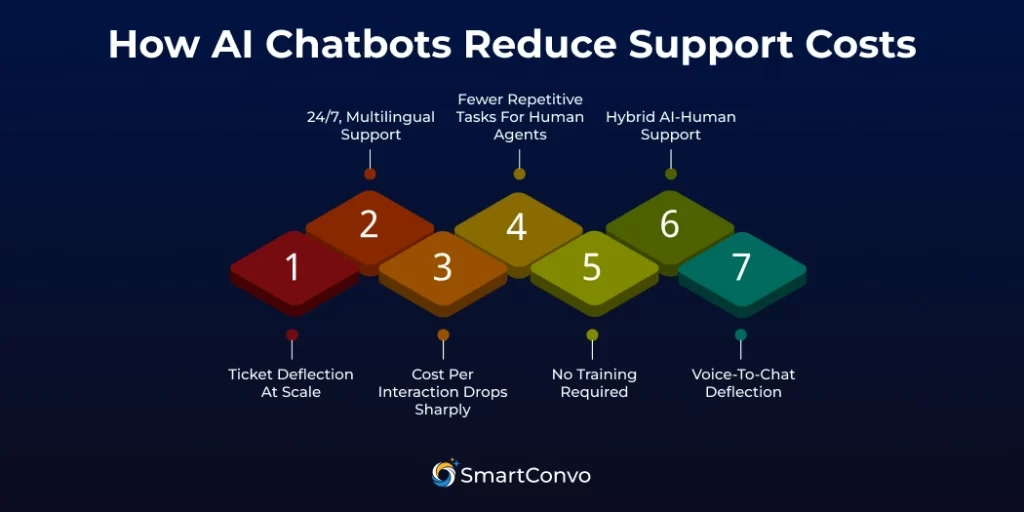
1. Ticket Deflection at Scale
AI chatbots handle repetitive queries — order status, returns, password resets — instantly and accurately, offering several benefits of implementing AI chatbots that go beyond cost savings. This deflects 30–50% of inbound tickets, allowing your human agents to focus on high-touch or revenue-impacting interactions.
2. 24/7, Multilingual Support
AI bots operate around the clock in multiple languages. There’s no need for night shifts or hiring for multilingual coverage — a direct reduction in labor costs.
3. Cost Per Interaction Drops Sharply
While a human-assisted chat may cost $5–8 per interaction, AI chatbot sessions cost cents. At scale, this brings substantial savings.
4. Fewer Repetitive Tasks for Human Agents
Chatbots can pre-fill support tickets, gather initial user details, and even suggest solutions. This improves agent productivity and reduces handle time.
5. No Training Required
Unlike human reps, AI chatbots don’t need continuous training or onboarding. Updating the underlying knowledge base instantly enhances bot performance.
6. Hybrid AI-Human Support
When bots can’t resolve an issue, they escalate seamlessly with full context to human agents. This hybrid model ensures quality without sacrificing efficiency.
7. Voice-to-Chat Deflection
Many companies use AI bots to reduce voice call volumes by routing users to chat, reducing telecom expenses, and shortening resolution cycles.
Real-World Use Cases: Where AI Chatbots Drive ROI

AI chatbots are transforming support across industries. For a deeper dive, check out these real-world AI chatbot use cases to see how businesses are scaling smarter.
E-Commerce
AI chatbots handle 60–80% of repetitive queries: order status, returns, shipping delays. Result: reduced support load during peak season.
SaaS & B2B
Bots can answer product questions, onboard users, and triage tech support issues, drastically reducing L1 ticket load.
Operations / Logistics
AI handles shipment updates, delay notifications, and vendor coordination across time zones — with no need for global teams.
Marketing & Sales
AI chatbots qualify leads, book demos, and capture intent data — helping sales teams focus on warm leads, not form submissions.
Across the board, AI chatbots create leverage, letting small teams punch above their weight.
No Credit Card Required | 14 days Free Trial
Build Your Chatbot
Traditional Chatbots vs AI-Powered Chatbots
| Feature | Traditional Bots | AI Chatbots |
|---|---|---|
| Rule-based Logic | Yes | No |
| Contextual Memory | No | Yes |
| Handles Ambiguity | No | Yes |
| Language Understanding | Basic | Advanced NLP |
| Self-Learning | No | Yes |
| Seamless Handoff | Limited | Yes |
| Personalization | Minimal | High |
Unlike static rule-based tools, AI-powered chatbots use machine learning to continuously improve, handle nuanced queries, and deliver personalized experiences.
Implementing AI Chatbots: A Cost-Conscious Guide
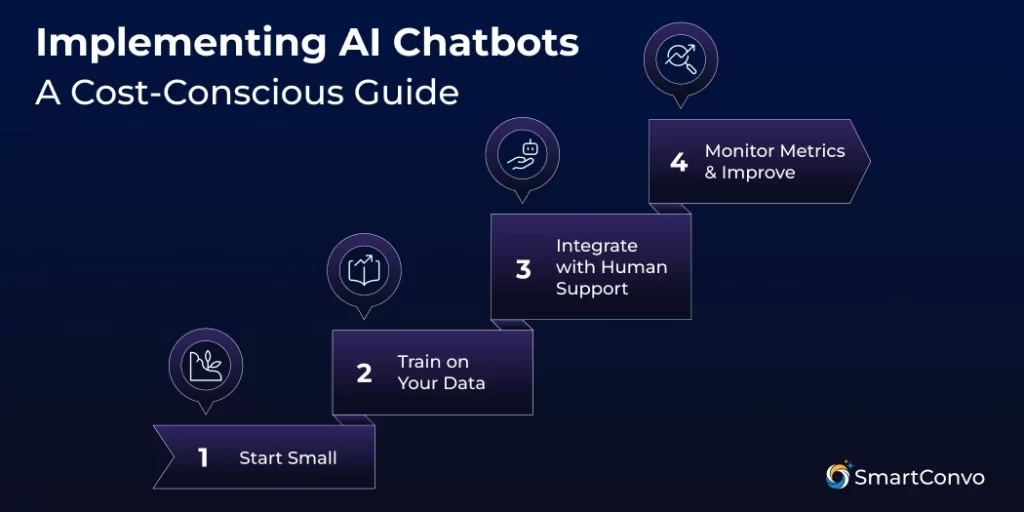
Step 1: Start Small
Deploy your AI chatbot in one domain, like handling FAQ or post-purchase inquiries. Measure its performance before expanding.
Step 2: Train on Your Data
Use your CRM logs, support tickets, and knowledge base to fine-tune the chatbot’s responses. Maintain tone and brand consistency.
Step 3: Integrate with Human Support
SmartConvo AI Chatbot platforms that support seamless agent handoff. Chatbots should pass complete interaction histories for efficient human follow-up.
Step 4: Monitor Metrics & Improve
Track deflection rates, ticket resolution times, CSAT scores, and average handling time. Continuously optimize for better ROI.
Consider Cost Factors
Account for AI chatbot development, subscription fees, integration with existing platforms, and ongoing maintenance. But compared to long-term human support costs, the investment pays off quickly.
Conclusion
If you’re a startup founder or CTO evaluating scalable customer support, AI chatbots aren’t just smart — they’re essential. They reduce support costs, improve user experience, and free up your human agents to focus on what truly matters.
At SmartConvo, we help startups deploy AI chatbot solutions tailored to your growth goals — with quick integration, custom workflows, and measurable ROI.
Get started with a free trial of SmartConvo AI Chatbot today and see how much you can save while delivering better service.
Frequently Asked Questions (FAQ)
They automate routine queries, reduce tickets, and lower staffing needs.
Yes, they understand context, learn from users, and offer smarter responses.
Startups in SaaS, e-commerce, finance, logistics, and healthcare see big gains.
Track deflection rate, FCR, CSAT, AHT, and cost per interaction.
Businesses often save 30–50% on support costs after chatbot adoption.

With 8+ years of experience as a software engineer in the IT field, an Elite in Back-end development, DevOps, and Project & Team Management. Read more