
AI Chatbot in Business: The Future of Effective Business Communication

Written By : Shantilal Matariya

Published on : July 8, 2025

4 min read


In today’s digital-first business environment, how you communicate is how you compete. Email is slow. Phone lines are expensive. Human support doesn’t scale. Meanwhile, your users expect real-time, personalized, and always-on experiences.
Enter AI chatbots—the new frontline of business communication.
According to Gartner, by 2025, 80% of customer interactions will be handled by AI.
If you’re a startup founder or CTO, you’re likely:
- Evaluating AI chatbots for business
- Comparing AI chatbots with traditional support/sales channels
- Looking for ROI and real-world use cases
- Curious about compliance and future capabilities of AI Chatbots
This guide answers all that—and more.
What Are AI Chatbots (And How Did We Get Here)?
An AI chatbot is software that uses Natural Language Processing (NLP) and Machine Learning (ML) to simulate human-like conversations in real-time.
Key capabilities:
- Understand complex queries
- Learn from past interactions
- Personalize replies based on user data
- Integrate with systems like CRMs, email, and Slack
Modern AI chatbots are powered by LLMs (Large Language Models) like OpenAI’s GPT, Google’s PaLM, or Meta’s LLaMA. Unlike rule-based bots, they don’t just respond—they reason, converse, and adapt.
Why AI Chatbots Are a Game-Changer for Startup Communication
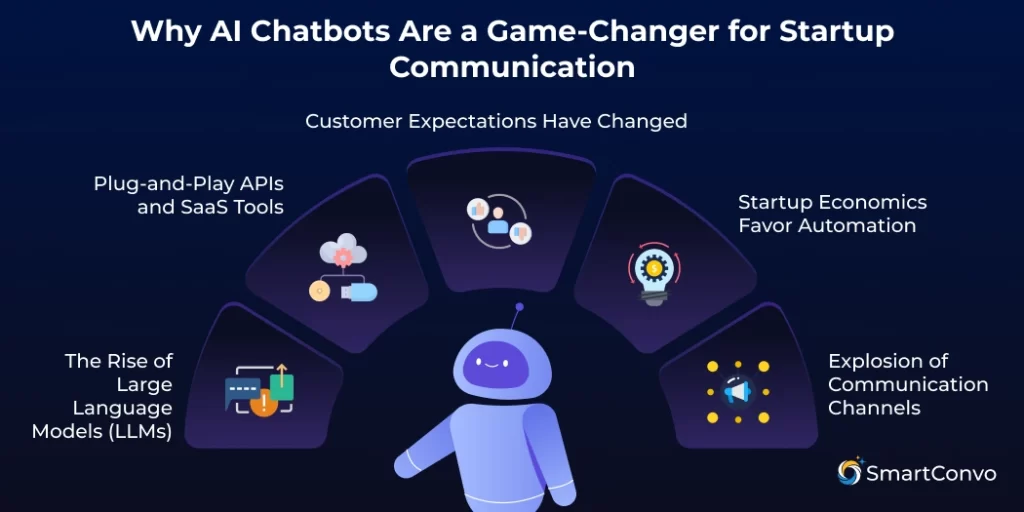
AI chatbots aren’t new, but their sudden explosion in relevance is due to a convergence of key factors:
1. The Rise of Large Language Models (LLMs)
Thanks to breakthroughs in LLMs (like GPT-4), chatbots now possess advanced reasoning, contextual understanding, and creative language generation abilities. They no longer just respond—they converse.
2. Plug-and-Play APIs and SaaS Tools
Tools like OpenAI API, Dialogflow, Rasa, and Botpress have made building smart bots faster and cheaper than ever before. You don’t need a team of ML engineers—you need product clarity and some strategic integration.
3. Customer Expectations Have Changed
Users expect 24/7 instant support, zero friction, and personalization. If your site doesn’t respond in seconds, your users bounce. AI chatbots meet these expectations at scale.
4. Startup Economics Favor Automation
You’re running lean teams with tight budgets. Hiring more support or sales reps may not be viable in the early stages—but chatbots scale instantly, without salary hikes or burnout.
5. Explosion of Communication Channels
From Instagram DMs to WhatsApp to in-app chat, customers interact across dozens of channels. AI chatbots provide centralized, consistent communication across them all.
AI Chatbot Use Cases Across Departments (Sales, Support, Operations, Marketing)
AI Chatbots in E-Commerce
- Answer FAQs instantly (returns, shipping, order tracking).
- Upsell based on user behavior.
- Example: Shopify stores using AI bots see a 10-20% increase in average order value (AOV).
AI Chatbots for Sales Teams
- Qualify leads via website and LinkedIn DMs.
- Schedule demos automatically.
- Example: A SaaS startup used AI bots to book 3x more demos in 60 days.
AI Chatbots for Customer Support
- Solve common issues (login help, billing questions).
- Reduce ticket volume and improve agent productivity.
- Example: SmartConvo bot reduced support ticket load by 40% for a B2B platform.
AI Chatbots for Marketing Automation
- Capture emails via conversational lead magnets.
- Deliver personalized blog content and event invites.
- Example: Marketing teams using bots for lead nurturing saw 2x higher conversion rates.
Choosing the Right AI Chatbot for Your Startup
Step 1: Define Your Use Case
- What’s my primary use case (support, sales, onboarding)
- Do I need deep integrations with tools like HubSpot, Slack, or Shopify?
- Do I need an LLM-based bot (GPT, Claude), or is a rule-based enough for now?
Step 2: Check Features
- LLM/NLP support (e.g., GPT, Claude)
- Integration with CRM/helpdesk
- Analytics (CSAT, resolution rate)
- Escalation to a human agent
Step 3: Build vs Buy
| Factor | Build | SaaS Chatbot |
|---|---|---|
| Speed | Slow | Fast |
| Flexibility | High | Medium–High |
| Maintenance | You | Vendor-managed |
Best AI Chatbot by Use Case
| Use Case | Recommended Platforms |
|---|---|
| E-commerce | Gorgias, Tidio, ManyChat |
| SaaS / B2B | Intercom, Drift, SmartConvo |
| Support | Zendesk Bot, HelpCrunch |
| Custom GPT | ChatGPT API, Rasa, Botpress |
| Internal Ops | Slack GPT, Notion AI + Zapier |
How to Get Started With AI Chatbots in Your Business
Step-by-Step:
- Pick a use case: Start with one pain point (support, lead gen, onboarding).
- Choose the right tool: Try SmartConvo or a trusted platform.
- Train the bot: Use past support tickets, FAQs, and sales scripts.
- Integrate smartly: Link your CRM, Slack, and web chat.
- Track performance: Use metrics like engagement rate, resolution time, and CSAT.
Conclusion
Startups today don’t compete on price or features alone. They compete on experience, speed, and personalization.
AI chatbots deliver all three, at scale. By implementing an AI Chatbot now, you future-proof your startup, reduce operational load, and deliver next-gen customer experiences.
The future is conversational. The future is AI-driven. And it’s already here.
Frequently Asked Questions (FAQ)
Faster replies, 24/7 support, and personalized responses create better user experiences.
Yes. Most modern bots integrate with HubSpot, Salesforce, Zoho, and custom CRMs.
No. Tools like SmartConvo come with pre-trained models and intuitive dashboards.
Top platforms use end-to-end encryption, data anonymization, and GDPR compliance to ensure safety.

With 8+ years of experience as a software engineer in the IT field, an Elite in Back-end development, DevOps, and Project & Team Management. Read more