
7 AI Chatbot Mistakes That Kill Conversions (and Fixes)

Written By : Shantilal Matariya

Published on : July 15, 2025

5 min read


AI chatbots are everywhere—from SaaS onboarding flows to 24/7 e-commerce support. They promise instant responses, reduced ticket volume, and happier customers. But here’s the hard truth: not all chatbots are created equal.
In fact, a poorly implemented AI chatbot can quietly kill your conversions. Customers get frustrated, leave unanswered, or bounce mid-conversation, and you’re left wondering why your support team is still drowning in tickets.
If you’ve invested in a chatbot (or are about to), this post is your safeguard. We’ll explore the seven most common—and costly—mistakes companies make with AI chatbots. And we’ll show you how solutions like SmartConvo help avoid these pitfalls to deliver real results.
7 Common Chatbot Mistakes and How to Avoid Them
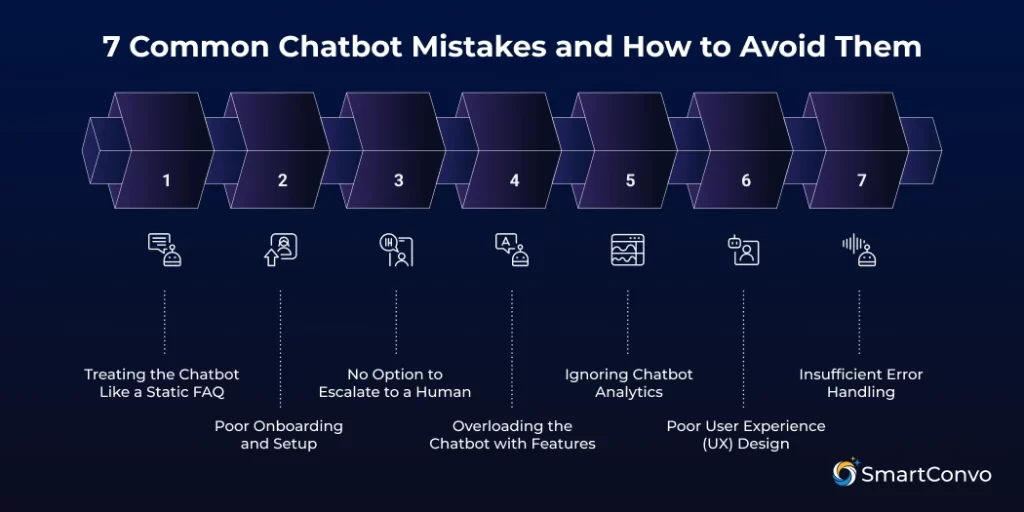
Mistake #1: Treating the Chatbot Like a Static FAQ
Too many businesses use chatbots as glorified FAQ widgets—hardcoded responses, no nuance, no context.
Why does this kill conversions?
- Feels robotic and impersonal
- Doesn’t adapt to user behavior or intent
- Leaves users digging for answers manually
What to do instead:
Use dynamic, AI-powered conversations that respond based on context and continuously learn from past interactions.
SmartConvo learns from real conversations, allowing it to adapt, refine, and get smarter with every interaction.
Real-world impact:
A SaaS client reduced repetitive ticket volume by 65% within 30 days of switching from a rigid bot to SmartConvo’s adaptive AI.
Mistake #2: Poor Onboarding and Setup
Your chatbot is only as good as the strategy behind it. If you launch without clear intent flows, error handling, or escalation paths, you’re setting users (and your support team) up for failure.
Why does this kill conversions?
- Confuses customers
- Doesn’t trigger the right conversation at the right time
- Leads to dead ends and abandoned sessions
What to do instead:
Design conversation flows around real user goals, not just what you think they need.
SmartConvo comes with pre-built templates, smart triggers, and guided onboarding to get you live in under an hour.
Mistake #3: No Option to Escalate to a Human
Even the smartest chatbot will eventually hit a wall. When that happens, users need a way out—a seamless handoff to a real human.
Why does this kill conversions?
- Creates frustration when the bot can’t answer complex questions
- Makes your brand feel cold or “bot-locked”
- Sends users to email or social media to get help (where they often don’t return)
What to do instead:
Use a hybrid model where the bot handles common issues and a human steps in for edge cases.
SmartConvo includes built-in human escalation, so when confidence is low or frustration is high, a support agent is just one click away.
Real-world impact:
An e-commerce brand saw a 40% jump in CSAT scores after enabling live agent handoff through SmartConvo.
Mistake #4: Overloading the Chatbot with Features
Trying to make your chatbot do everything is a fast track to poor UX. Complex flows, irrelevant responses, and too many paths make users abandon before they get what they need.
Why does this kill conversions?
- Confuses users with too many options
- Increases response time
- Fails to address the core support needs
What to do instead:
Start lean. Focus on the top 5–10 most common questions and build from there.
SmartConvo helps businesses identify and prioritize high-volume intents so they can automate what matters most first.
Mistake #5: Ignoring Chatbot Analytics
You can’t improve what you don’t measure. If you’re not looking at conversation drop-offs, fallback rates, or top queries, you’re flying blind.
Why does this kill conversions?
- Let broken flows stay live
- Misses high-impact optimization opportunities
- Makes support data invisible to decision-makers
What to do instead:
Track performance weekly. Use analytics to identify where users get stuck, what they ask most, and what’s working well.
SmartConvo provides real-time analytics with actionable insights, so you can continually improve performance and reduce support load.
Example:
A startup used SmartConvo’s insights to optimize its top 3 flows and reduce tickets by 78% in under 2 months.
Mistake #6: Poor User Experience (UX) Design
A chatbot isn’t just about what it says—it’s also about how the experience flows. Sloppy design can cause frustration even if the bot technically has the right answers.
Why does this kill conversions?
- Long-winded messages overwhelm users
- Buttons are hard to tap or are missing entirely
- Critical steps are buried under poor logic or structure
What to do instead:
Design with the end-user in mind:
- Use short, scannable messages
- Include quick replies and clear CTAs
- Maintain visual hierarchy and conversational logic
SmartConvo helps you create streamlined, user-friendly chat flows with built-in UX best practices and templates.
Mistake #7: Insufficient Error Handling
Even the best chatbot will misinterpret a message now and then. But what happens next determines whether the user sticks around or bounces out.
Why does this kill conversions?
- Users get stuck in loops when the bot doesn’t understand
- “I don’t know” messages break trust
- Dead ends lead to frustration and churn
What to do instead:
Plan for failure states. Build graceful error responses and offer clear next steps or escalation options.
SmartConvo automatically detects low-confidence queries and routes to the best fallback—whether it’s a helpful article or a live agent.
Real impact:
SmartConvo customers see up to 42% more completed sessions after improving fallback and error handling logic.
Conclusion
AI chatbots have the power to transform your customer experience—but only if they’re done right. You might wonder can ai chatbots make mistakes? The answer is yes, but by avoiding common pitfalls like poor setup, lack of personalization, or ignoring analytics, you can ensure your chatbot drives real results.
By avoiding these 7 critical mistakes—like poor setup, lack of personalization, or ignoring analytics—you set your business up for more than just fewer support tickets. You gain happier customers, faster resolutions, and higher conversion rates.
But you don’t have to fix it all alone.
SmartConvo makes it easy to build a chatbot that works for you, not against you—smart, scalable, and designed to actually improve support outcomes.
Frequently Asked Questions (FAQ)
Static replies, no escalation, poor UX, bad setup, and ignoring analytics.
Yes—if poorly implemented, they frustrate users and increase bounce rates.
Focus on user intent, personalization, clear flows, and data-driven optimization.
Automate FAQs with a smart chatbot like SmartConvo that learns and adapts.
It ensures users get help when the bot can’t answer, preventing drop-offs.

With 8+ years of experience as a software engineer in the IT field, an Elite in Back-end development, DevOps, and Project & Team Management. Read more