
Do You Really Need an AI Chatbot for Companies Like Yours?

Written By : Shantilal Matariya

Published on : July 29, 2025

8 min read


Technology is changing fast, and businesses everywhere are starting to use tools like AI chatbots to keep up. Years ago, it was hard to share information quickly — now, everything is just a click away. As the world becomes more digital, companies are using automation to save time, cut costs, and serve customers better.
One of the most popular tool is the AI chatbot. It can answer questions, handle simple tasks, and even help with sales—all without human help. Businesses big and small use chatbots to improve how they work.
But here’s the big question like: Would a chatbot be right for every business? Does your business need an AI chatbot, or is it just another trend?
For some, chatbots are a game-changer. For others, they might not add much value. It all depends on your needs, goals, and readiness to use the tech.
In this article, you’ll learn:
- What AI chatbots can do
- Why do companies use chatbots
- real-world use cases by industry
- How to know if your business is ready
By the end, you’ll be able to confidently decide if an AI chatbot for companies is the right move for your business — or if it can wait.
What Is an AI Chatbot for Companies?
An AI chatbot for companies is a smart tool that uses artificial intelligence (AI) and natural language processing (NLP) to talk with users in a human-like way. It works in real-time on platforms like websites, messaging apps, and customer portals.
Unlike traditional rule-based chatbots that follow predefined scripts, AI chatbots can learn from data, improve over time, and handle more complex, context-aware conversations. They can interpret user intent, understand multiple languages, and deliver relevant responses — all without needing a human agent.
Key Features of AI Chatbots for Companies:
- 24/7 automated support for customers and employees
- Contextual understanding of user queries
- Integration with business tools like CRMs, helpdesks, or e-commerce platforms
- Multi-channel availability (website, WhatsApp, Messenger, etc.)
- Continuous learning through machine learning models
Are AI Chatbots Safe for your company?
Security is a big concern for businesses using AI chatbots, and it should be. These tools handle sensitive information like personal details, payment data, and confidential business info.
The good news? Trusted AI chatbot platforms like smartconvo use strong security measures, such as end-to-end encryption, secure data transmission, and compliance with rules like GDPR and HIPAA. But security isn’t just about the tech—it’s also about how you set up and manage your chatbot.
Important steps include controlling who can access data, securing integrations with other systems, and running regular security checks. Some companies use a hybrid setup, where sensitive conversations go to human agents, and the chatbot handles simple questions.
Privacy is just as important. Customers need to know when they’re talking to an AI, how their data is being used, and what’s being stored. Clear privacy policies and consent options help build trust.
Common Problems AI Chatbots Solve in Companies
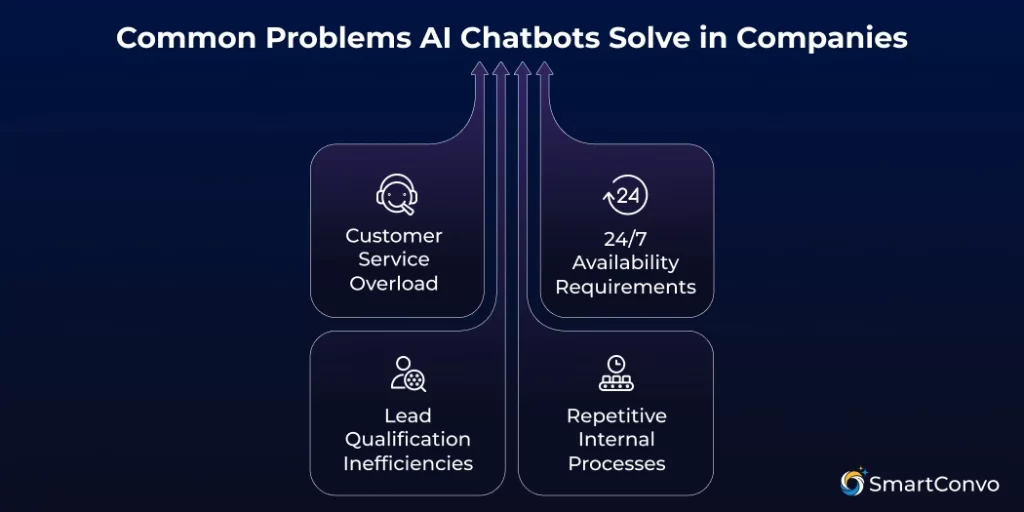
AI chatbots can help solve common business problems that waste time and lower customer satisfaction. By understanding these issues, you can see if a chatbot would be helpful for your company.
In fact, AI chatbots benefits for companies statistics show they improve response time, reduce support costs, and boost overall customer experience.
Customer Service Overload
Many companies deal with too many repetitive customer questions, which can overwhelm support teams. AI chatbots can answer up to 80% of common questions, freeing up human agents to handle more complex issues that need personal attention or expert knowledge.
24/7 Availability Requirements
Customers want quick responses anytime, no matter the time zone or business hours. Chatbots are available 24/7, saving the cost of hiring staff for multiple shifts.
Lead Qualification Inefficiencies
Sales teams often lose time on leads that don’t go anywhere or can’t respond quickly to interested customers. Sales chatbots also can help by talking to visitors right away, asking the right questions, and sending good leads to the right salespeople.
Repetitive Internal Processes
Chatbots aren’t just for customer service – they can also help with internal tasks like IT support, HR automation, or admin requests. This reduces the workload for support teams and makes things run more smoothly.
5 Signs Your Company Really Needs an AI Chatbot
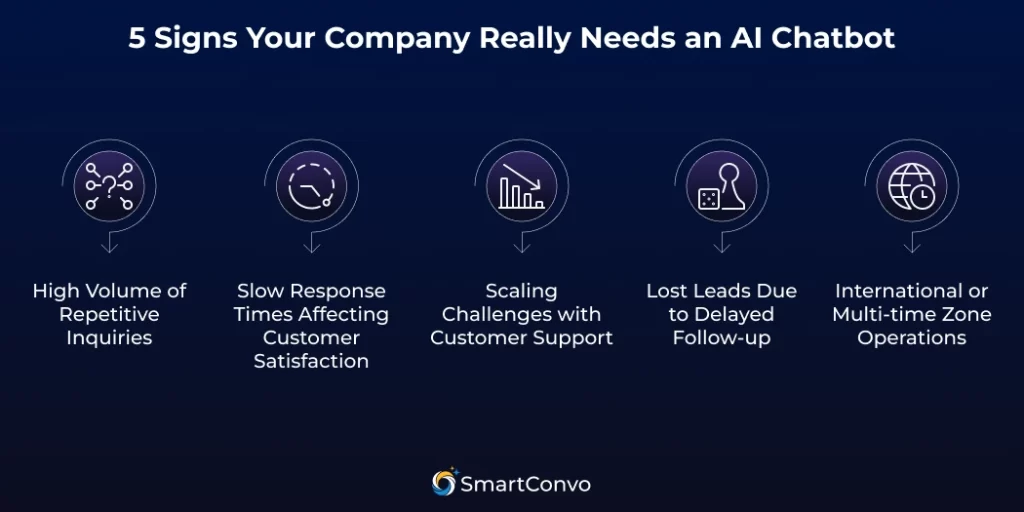
Knowing when to use an AI chatbot means taking a good look at your current challenges and goals. Here are five signs your business could benefit from chatbot technology.
High Volume of Repetitive Inquiries
If your customer service team keeps answering the same questions—like business hours, pricing, or basic troubleshooting—an AI chatbot can take over and handle these efficiently while staying consistent.
Slow Response Times Affecting Customer Satisfaction
When customers wait hours or days for simple answers, they get frustrated, and satisfaction drops. Slow responses can lead to lost loyalty and more complaints.
If you’re noticing slow response times or customer feedback about delayed support, it might be time to try a chatbot. AI Chatbots provide instant replies and quick solutions to common questions, keeping customers happy while letting your team focus on tougher problems.
Scaling Challenges with Customer Support
As businesses grow, hiring more staff can get costly and difficult. If you’re finding it hard to keep up with customer inquiries while maintaining good service, chatbots can help. They’re a flexible and affordable solution that grows with your business.
Lost Leads Due to Delayed Follow-up
Companies that respond to leads within five minutes are 100 times more likely to connect than those that wait 30 minutes. If your sales team isn’t available to respond quickly, a chatbot can step in, talk to prospects right away, and collect their information.
International or Multi-time Zone Operations
Businesses serving global customers often struggle to provide support across time zones. Instead of hiring costly staff for 24/7 coverage, chatbots can answer questions during off-hours and pass urgent issues to human agents when needed.
Industry Use Cases: Where AI Chatbots Work Best
Different industries use AI chatbots in different ways, depending on their needs. Knowing how chatbots work in various sectors can help you see how they might benefit your business.
E-commerce and Retail
Ecommerce businesses are turning to AI chatbots to improve the shopping experience. These ecommerce AI chatbots help customers with product recommendations, order tracking, processing returns, and answering inventory questions.
By offering personalized suggestions and fast support, AI chatbots not only boost sales but also increase customer satisfaction. Plus, they help online retailers save on support costs by automating common tasks, freeing up teams to handle more complex issues.
Healthcare and Telemedicine
Healthcare organizations use chatbots to help with scheduling appointments, checking symptoms, sending medication reminders, and providing patient education. These tools make information more accessible while keeping doctors in charge of important medical decisions.
Financial Services
Banks use AI chatbots to help with tasks like checking balances, viewing transaction history, sending fraud alerts, and giving simple financial advice. Security is especially important in this field.
Real Estate
Property companies use chatbots to qualify leads, share property details, schedule viewings, and answer common questions about locations, prices, and amenities.
Utilities and Energy
An AI chatbot for power companies can help with outage reports, billing questions, service requests, and energy usage details. This reduces the load on call centers, especially during busy times or emergencies.
Should You Invest in an AI Chatbot for Companies?
Deciding to use an AI chatbot shouldn’t just be about following trends or copying competitors. Instead, focus on how a chatbot can solve specific business problems and improve key metrics.
Start by estimating the potential ROI. For example, consider using an AI chatbot to reduce customer service costs by handling routine questions, speeding up response times, and lowering the need for additional support staff. Think about both direct savings and indirect benefits like happier customers and increased conversions.
Check your technical setup and resources. Managing a chatbot requires ongoing updates, training, and improvements. Make sure you have the skills in-house or the budget to hire external help.
Begin with a small test project targeting specific tasks, instead of rolling out a chatbot for everything at once. This lets you see what works, adjust your plan, and build confidence before expanding.
Lastly, the right chatbot depends on your industry and business size. Research platforms that fit your needs and can connect easily with your current systems.
Making the Smart Choice for Your Business Future
Deciding if your company needs an AI chatbot often starts with the question, “do I need a chatbot?” The answer depends on how well its features align with your business needs. The best results happen when businesses have clear goals, realistic expectations, and a plan to keep improving the chatbot over time.
If you’re dealing with common issues like too many repetitive questions, trouble scaling, or slow response times, an AI chatbot could be a great solution. But success depends on careful planning, choosing the right platform, and ongoing updates.
Before fully committing, try running a small pilot program with a specific task. This helps you test how the chatbot works in real-life situations and identify any challenges.
The key is to thoughtfully use AI while keeping the personal, human touch where it matters most.
Ready to take the next step?
Start exploring AI chatbot solutions with Smartconvo — a platform designed to help companies like yours automate smarter, respond faster, and scale without losing the human connection.
Frequently Asked Questions (FAQ)
AI Chatbot costs range from $9/month for basic plans to thousands for enterprise solutions. Consider all expenses.
Yes, they help small teams handle more inquiries, capture leads, and offer 24/7 support without extra staff.
Absolutely. AI Chatbots can be tailored with scripts, workflows, and responses for industry-specific needs.
If you're overwhelmed by support tasks or missing leads after hours, it's time to explore chatbot solutions.

With 8+ years of experience as a software engineer in the IT field, an Elite in Back-end development, DevOps, and Project & Team Management. Read more