
The Future of Generative AI Chatbots: Trends & Insights

Written By : Shantilal Matariya

Published on : August 4, 2025

9 min read


Generative AI chatbots are transforming the way businesses communicate with customers. In the past, most chatbots followed fixed rules. They could only answer simple questions and often got stuck when conversations became complex. But things have changed.
With the power of Generative AI and Large Language Models (LLMs) like GPT-4, Claude, and Gemini, chatbots can now engage in real conversations, understand context, and provide more intelligent responses. They can even create content, explain things, and solve problems—just like a real person.
So, what’s next for these smart chatbots? What new trends are shaping their future? And how can your business get ready?
We’ve got all the answers right here. In this blog, we’ll explore the future of generative AI chatbots, including the latest trends, use cases, and what your company can do to stay ahead of the curve.
What is the future of generative AI chatbots?
The future of generative AI chatbots looks very exciting. These chatbots are getting smarter and more useful every day. Soon, they won’t just work with text—they’ll understand voice, images, and even video. Some will be used in virtual reality or on smart glasses.
They will also give more personal help, remember what you talked about before, and adjust how they respond based on your needs. Businesses will use them to save time, help customers faster, and improve service.
As long as companies use them responsibly—keeping data safe and being honest with users—AI chatbots will become a big part of daily life and work.
Current State of Generative AI Chatbots
Today’s AI chatbots are a big improvement over older versions. Tools like GPT-4, Claude, and Gemini can create content, write code, solve problems, and analyze data in smart and creative ways.
These AI chatbots are great at keeping track of conversations, sounding human, and adjusting their tone to match your style. They can summarize documents, write ads, fix code, and explain complex ideas clearly.
But there are still some issues. Chatbots can sometimes give wrong information, struggle with very specialized topics, and can’t learn from users without being retrained. They also have trouble accessing real-time updates and staying consistent in long conversations.
Top Trends Shaping the Future of Generative AI Chatbots

Here are some top trends that are driving innovation and shaping the potential of generative AI chatbots:
Multimodal AI Capabilities
The next generation of chatbots will handle different types of content at the same time. You’ll be able to upload images for analysis, talk about text documents, and get video explanations—all in one smooth conversation.
Hyper Personalization and Context Awareness
Future AI chatbots will be smarter. They’ll remember past conversations, learn what you like, and adjust their responses to fit your needs. This means they won’t just remember simple preferences—they’ll match your communication style, skill level, and the way you work.
Agentic AI & Autonomous Actions
The future of generative AI chatbots will move from answering questions to taking actions on behalf of users—booking meetings, resolving support tickets, submitting forms, and more. This shift will increase productivity and automation. This new ability is called Agentic AI, where chatbots act more like helpful assistants that can take action.
Real-Time Learning and Adaptation
Advanced AI chatbots will keep learning from conversations without needing to be retrained completely. They’ll adjust to new information, fix mistakes based on user feedback, and get better at responding over time.
Industry-Specific AI Assistants
AI Chatbots are now being designed for specific industries like healthcare, law, finance, and engineering. These specialized chatbots provide more accurate answers and expert advice in their fields.
Enhanced Security & Compliance
As AI chatbots handle more sensitive data, it’s becoming more important to focus on AI rules, data privacy, and following regulations like GDPR and HIPAA. Being open and ethical with AI will give companies an edge.
Augmented and Virtual Reality (AR/VR) Integration
As AR and VR technologies mature, generative AI chatbots are becoming an essential part of immersive digital environments. These AI-driven assistants will enhance user experiences in virtual showrooms, training simulations, metaverse platforms, and augmented shopping experiences.
Key Insights for Businesses Adopting Generative AI Chatbots
Generative AI and the future of work go hand in hand. Companies that use this technology effectively can boost productivity, improve customer satisfaction, and work more efficiently.
The best approach is to use AI to support people, not replace them. For example, chatbots can handle simple tasks, provide quick answers, and manage personalized interactions at scale. Meanwhile, people are still important for making complex decisions, building relationships, and creating innovative strategies.
Using generative AI in businesses takes careful planning. Start small with clear use cases, like customer support, help desks, or content creation. Track results, gather feedback, and expand as you see success.
High-quality data is critical. AI chatbots work best when trained with accurate, relevant, and up-to-date data. Businesses need to invest in keeping their data clean and up-to-date to ensure strong chatbot performance.
How Businesses Can Prepare for the Future of AI Chatbots
To succeed with AI chatbots, you need to prepare strategically. Start by aligning chatbot use with your business goals and integrating them into existing workflows without causing disruptions.
Identify where chatbots can add value quickly, like customer service, employee onboarding, tech support, or content creation. Running pilot programs in these areas can help you learn and prove their value.
Train your team to work with chatbots effectively. They should know when to use chatbots, their capabilities, and when human help is still needed. This requires both technical training and adjusting to new ways of working.
Set clear rules for using AI. Create guidelines to ensure data privacy, accurate content, and ethical AI practices. Address issues like quality control, liability, and how to handle complex problems.
Plan your infrastructure early. Advanced AI chatbots might need powerful computing, specific software, and strong security. Proper planning helps avoid delays and unexpected costs.
Challenges & Ethical Considerations
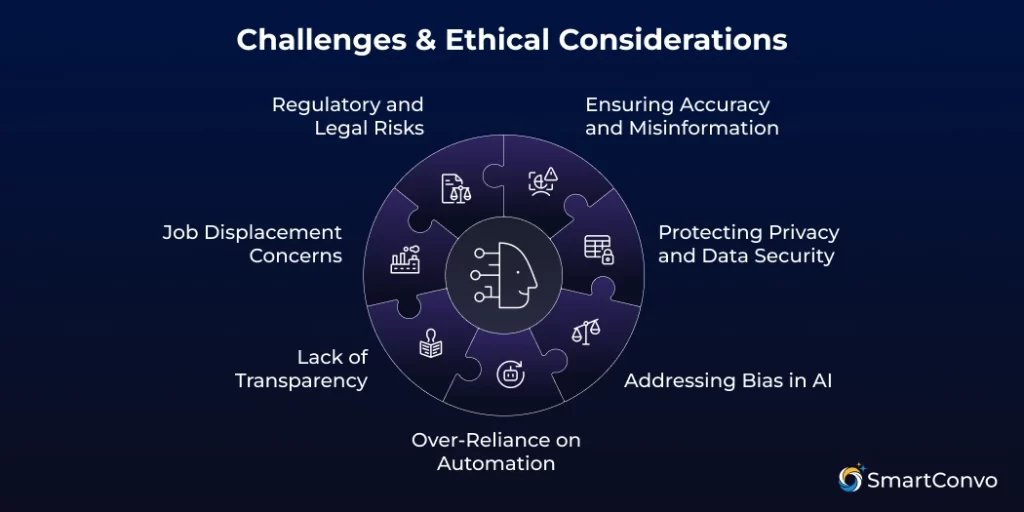
Generative AI chatbots are transforming the way businesses interact with customers, but they also come with challenges that need to be addressed carefully. Here are some key issues and how organizations can tackle them:
1. Ensuring Accuracy and Misinformation
One of the biggest challenges is accuracy. AI chatbots can sometimes provide incorrect or misleading information. This happens because they generate responses based on patterns in data, not real understanding.
If a chatbot gives wrong answers, it can confuse users or damage trust in your brand.
2. Protecting Privacy and Data Security
Privacy is another important concern. Chatbots often handle sensitive information like names, addresses, or payment details.
If this data isn’t stored and managed properly, it could be exposed or misused. Businesses need to ensure that customer data is safe and handled responsibly.
3. Addressing Bias in AI
Bias in AI is also a growing issue. Since these models are trained on large datasets from the internet, they may reflect harmful stereotypes or biased viewpoints.
This can lead to unfair or offensive chatbot responses, which could harm user experience or your company’s reputation.
4. Over-Reliance on Automation
While automation can save time and improve efficiency, relying too much on chatbots can make customer service feel impersonal.
Some situations—like emotional conversations or complex support issues—still require human understanding and empathy. Finding the right balance between AI and human support is key.
5. Lack of Transparency
Users often don’t know when they’re speaking to a chatbot or how their data is being used. This lack of transparency can create discomfort and reduce trust. It’s important to communicate that a user is interacting with AI and explain what the chatbot can and cannot do.
6. Job Displacement Concerns
As businesses automate more tasks using AI, there’s growing concern about job loss. Employees may feel threatened by chatbot technology if they see it as a replacement rather than a support tool.
Businesses should consider how to use AI in ways that empower workers and create new opportunities.
7. Regulatory and Legal Risks
AI is still a developing field, and laws around its use are constantly evolving. If a chatbot violates privacy laws or makes harmful decisions, businesses could face legal consequences. Staying informed and compliant is necessary for responsible AI adoption.
Future Outlook: What to Expect in the Next Year?
Over the next year, AI chatbots are expected to get much better and easier to use. They’ll become more accurate, work more smoothly with existing business tools, and offer solutions tailored to specific industries.
Costs are also dropping, making advanced chatbots affordable for smaller businesses. As the technology improves and competition grows, these tools are becoming more powerful and less expensive to implement.
New rules and regulations will likely appear, giving businesses clearer guidelines on how to use AI responsibly, especially when it comes to privacy, accuracy, and ethics.
AI Chatbots will also integrate more easily with tools like CRMs, productivity apps, and other business software, helping create smarter and more efficient workflows.
Conclusion
The future of generative AI is set to change how businesses work, serve customers, and grow. Companies that start preparing now will be ready to take advantage of these changes.
Success isn’t just about using new technology—it’s about thinking strategically. Tools like SmartConvo, powered by advanced AI chatbots, can help improve your business, meet your customers’ needs, and support your goals. The businesses that succeed will see AI chatbots as partners, not just tools.
This shift is already happening. It’s not a matter of whether your business will use AI chatbots, but how quickly you can prepare. Start planning today—the future of business communication is coming faster than you think.
Frequently Asked Questions (FAQ)
The next big thing after generative AI is Agentic AI, where AI can make decisions and take actions autonomously.
No, they support humans by automating tasks but still need human oversight and decision-making.
SmartConvo helps businesses automate support and boost engagement with AI-driven conversations.
Start with small use cases like support or FAQs, then expand with training and feedback.
Early adoption leads to better service, lower costs, and future-ready customer experiences.

With 8+ years of experience as a software engineer in the IT field, an Elite in Back-end development, DevOps, and Project & Team Management. Read more