
Pop-ups vs AI Chatbots: Which Works Better for CRO?

Written By : Shantilal Matariya

Published on : August 21, 2025

6 min read


Getting traffic to your website is only half the battle—the real challenge lies in converting that traffic into paying customers. That’s where Conversion Rate Optimization (CRO) strategies come into play. For years, businesses relied heavily on pop-ups to capture emails, promote offers, and reduce cart abandonment. While effective at grabbing attention, pop-ups often interrupt the user experience and risk frustrating visitors.
On the other hand, chatbots—especially AI-powered Chatbot ones—are transforming how brands engage with their audience. Unlike static pop-ups, chatbots provide real-time, interactive conversations that guide users, answer questions, and recommend products or services. If you’re looking for a more effective way to engage with your visitors, consider adding an AI chatbot to your website—it can drastically improve user experience and boost conversions. This raises an important question for modern marketers: Pop-ups vs chatbots—which works better for CRO?
In this article, we’ll compare Pop-ups vs AI Chatbots vs head-to-head, looking at their strengths, weaknesses, and impact on customer experience. By exploring real-world use cases and conversion data, we’ll show why Pop-ups vs Chatbots for CRO isn’t just a debate—it’s a shift toward smarter, more personalized tools like SmartConvo that drive sustainable growth.
The Role of Pop-ups in CRO
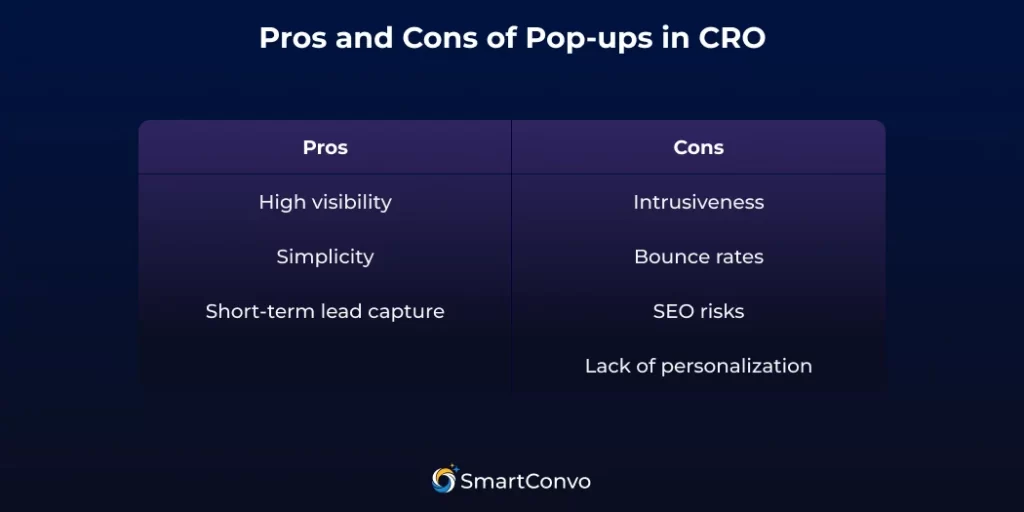
Pop-ups earned their place in CRO because of one thing: visibility. By appearing front and center, they force users to make a choice—sign up, take an offer, or dismiss. For businesses chasing quick wins, they worked.
Pros of Pop-ups in CRO
- High visibility: No user can miss them.
- Simplicity: Easy to create and deploy with basic tools.
- Short-term lead capture: Discount codes, newsletter sign-ups, and limited-time offers often perform well in the moment.
Cons of Pop-ups in CRO
But visibility comes at a cost.
- Intrusiveness: Studies show that 73% of users dislike pop-ups because they interrupt the browsing experience.
- Bounce rates: Poorly timed pop-ups can increase site abandonment.
- SEO risks: Intrusive mobile interstitials can harm rankings. With enterprise SEO services, businesses implement user-friendly pop-ups, improve mobile UX, and stay compliant with Google guidelines to protect visibility.
- Lack of personalization: Most pop-ups display the same message to everyone, regardless of context.
In other words, while pop-ups may deliver short-term conversions, they often erode trust and degrade the overall user experience.
The Rise of AI Chatbots in CRO
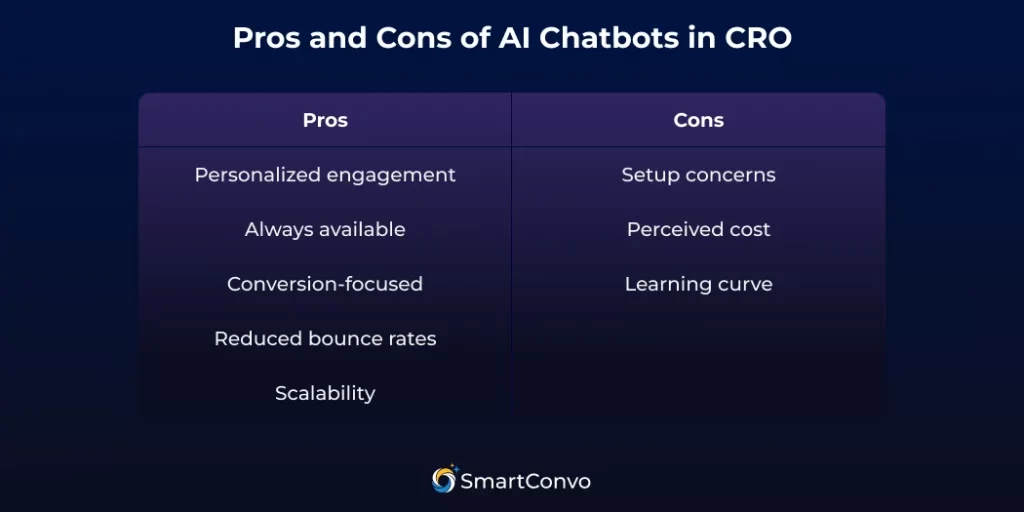
Chatbots started as basic FAQ tools, but today’s AI-powered versions are far more sophisticated. Platforms like SmartConvo leverage natural language processing (NLP) and real-time data to create conversations that feel personalized, helpful, and human.
Pros of AI Chatbots in CRO
- Personalized engagement: Unlike static pop-ups, chatbots tailor interactions to the user’s behavior, history, and intent.
- Always available: They respond 24/7, capturing leads even outside business hours.
- Conversion-focused: AI chatbots can qualify leads, recommend products, and guide users toward specific actions.
- Reduced bounce rates: Instead of disrupting the experience, they provide assistance, keeping users engaged longer.
- Scalability: One chatbot can handle thousands of conversations simultaneously without additional costs.
Cons of AI Chatbots in CRO
- Setup concerns: Businesses sometimes fear that integrating a chatbot will be complicated.
- Perceived cost: AI solutions can seem expensive compared to free pop-up tools.
- Learning curve: Users worry chatbots may feel robotic or irrelevant without proper training.
The good news is that modern AI chatbot platforms—especially SmartConvo—are designed to be plug-and-play, requiring little to no technical expertise to launch.
Pop-ups vs. AI Chatbots: Which Works Better for CRO?
To make the decision clearer, let’s compare both tools across key CRO dimensions.
| Feature / Benefit | Pop-ups | AI Chatbots |
|---|---|---|
| User Experience | 82% of users say pop-ups are annoying | 63% of consumers prefer messaging over forms |
| Conversion Impact | Average conversion rate: ~3% | Conversion uplift: 10–20% on average |
| Lead Quality | Collects basic emails with low intent | 80% of chatbot leads are more qualified due to context-driven conversations |
| Customer Engagement | 1-way, interruptive | 2-way, real-time dialogue (engagement rates 2–3x higher than pop-ups) |
| Scalability | Same message for all visitors | Adapts dynamically to user behavior |
| Personalization | Limited to generic offers (e.g., discounts) | Personalized responses based on user questions & browsing patterns |
| Data & Insights | Minimal (email capture only) | Rich analytics: FAQs, intent, buyer journey mapping |
| Implementation Effort | Quick setup, but rigid | Plug-and-play integrations, no coding required |
| ROI Potential | Low–medium: quick wins, but declining returns | High: boosts conversions, reduces support tickets, increases lifetime value |
Why AI chatbots are Winning in Conversion Rate Optimization (CRO) in 2025
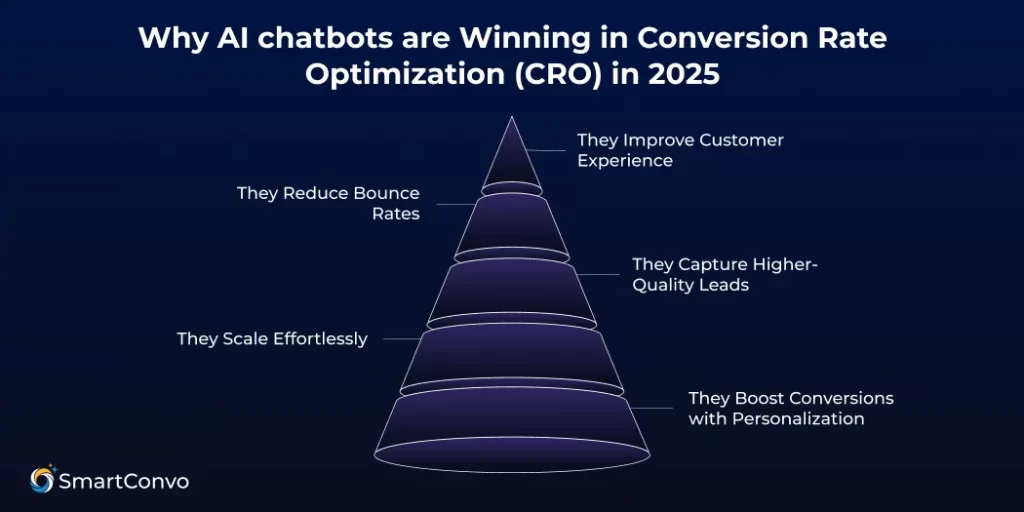
The digital landscape has shifted. Users expect seamless, personalized experiences, not interruptions. Let’s look at why AI chatbots are emerging as the preferred CRO tool:
1. They Improve Customer Experience
Pop-ups interrupt. Chatbots assist. When visitors are browsing, a chatbot can ask, “Looking for something specific?” or “Need help finding the right plan?”—guiding users without breaking their flow.
2. They Reduce Bounce Rates
Instead of giving users a reason to leave (like an intrusive pop-up), chatbots increase dwell time by offering relevant help or content. This engagement leads to lower bounce rates and higher conversions.
3. They Capture Higher-Quality Leads
Anyone can enter a random email into a pop-up form. But chatbots qualify leads in real time, asking questions like:
- “Are you looking for personal or business use?”
- “What’s your budget range?”
By the end of the conversation, businesses have segmented, actionable leads instead of a generic email list.
4. They Scale Effortlessly
Hiring more support agents to handle leads is costly. Pop-ups can’t scale beyond a static message. But AI chatbots can handle unlimited conversations simultaneously without extra cost, making them ideal for growing businesses.
5. They Boost Conversions with Personalization
Modern AI bots don’t just respond; they recommend. For example, an e-commerce chatbot can suggest products based on browsing history, while a SaaS chatbot can guide users to the right plan. According to research, personalization can increase conversions by 20% or more—a clear advantage over generic pop-ups.
— Alex R., Founder of a SaaS Startup

Conclusion
Pop-ups have long been a go-to tactic for capturing attention, but today’s customers expect more than a quick discount or form. While pop-ups may generate short-term conversions, they often disrupt the user experience and risk driving visitors away.
AI chatbots, on the other hand, offer a smarter, more sustainable path to higher conversions. By engaging users in real-time conversations, personalizing their journey, and providing instant support, chatbots not only capture leads but also build trust and long-term customer relationships.
For business owners and startup founders, the choice is clear: if you want lasting CRO results that scale with your growth, AI chatbots are the better investment.
Frequently Asked Questions (FAQ)
Yes, but they often annoy users and only give short-term conversion gains.
Yes, chatbots boost conversions by 10–20% with real-time engagement.
Not always, but they provide a smarter, more user-friendly CRO approach.
No, tools like SmartConvo are plug-and-play with no coding required.
Yes, they scale support, capture leads, and fit startups’ tight budgets.

With 8+ years of experience as a software engineer in the IT field, an Elite in Back-end development, DevOps, and Project & Team Management. Read more