
How AI Chatbots Reduce Human Agent Training Time

Written By : Shantilal Matariya

Published on : September 3, 2025

3 min read


AI chatbots reduce human agent training time by handling repetitive inquiries, guiding agents in real-time, and serving as knowledge-sharing tools. This allows businesses to onboard agents faster while maintaining consistent customer service quality.
How AI Chatbots Reduce Human Agent Training Time
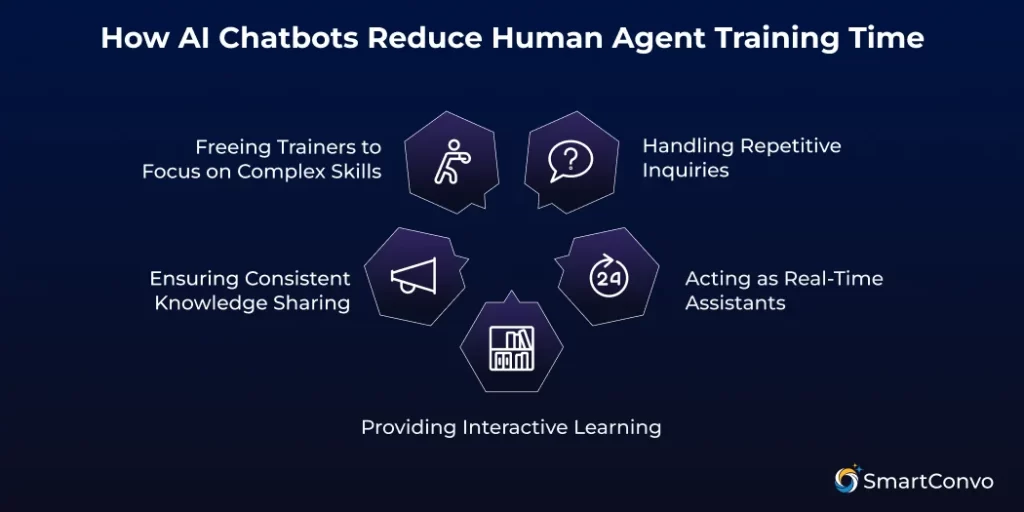
1. Handling Repetitive Inquiries
AI chatbots can manage FAQs such as password resets, order tracking, and account updates. This means agents don’t need to learn every single routine response during training.
2. Acting as Real-Time Assistants
Chatbots can suggest next best responses or provide knowledge-base links in real-time during customer interactions. New agents learn on the job without needing to memorize large amounts of information in advance.
3. Providing Interactive Learning
Instead of traditional classroom-style training, chatbots can quiz agents, simulate conversations, and guide them through scenarios. This makes learning more engaging and efficient.
4. Ensuring Consistent Knowledge Sharing
AI chatbots maintain a centralized knowledge base, so every new agent receives the same standardized information. This reduces errors caused by inconsistent training.
5. Freeing Trainers to Focus on Complex Skills
By automating the basics, chatbots give trainers more time to coach agents on soft skills like empathy, problem-solving, and conflict resolution.
Why Training Human Agents Is a Bottleneck
Human Learning Curve
- Time and Resources: Training human agents requires significant time and financial investment to build the necessary knowledge, skills, and expertise.
- Consistency and Quality: Performance can be inconsistent, particularly when handling complex or repetitive tasks, which slows down ramp-up time and affects reliability.
Scalability Limitations
- Limited Capacity: There is only so much training that can be delivered at once, limiting how many agents can be effectively onboarded in a given period.
- Geographical and Structural Constraints: Scaling support across different locations or organizational structures adds complexity, making rapid deployment difficult.
Adaptation to New Technologies
- Resistance to Change: Employees may resist adopting new AI-driven tools and workflows, delaying integration into daily operations.
- Skill Gap: Many agents lack the technical expertise required to work effectively alongside AI, necessitating additional training that further extends the onboarding timeline.
Maintenance and Development Costs
- Ongoing Training: Unlike AI systems, human agents need continuous retraining to stay current with new products, technologies, and customer expectations.
- Expertise Retention: Retaining knowledge within a workforce is difficult, as turnover leads to the loss of valuable expertise that must be re-developed with each new hire.
The AI-Human Interface
- Human Oversight for AI: While AI can assist significantly, many processes still require human oversight to review, correct, and approve AI-generated responses—adding another layer of responsibility that can slow down efficiency.
What This Means for Businesses
If your customer support team struggles with:
- High training costs
- Long onboarding cycles
- Inconsistent customer interactions
…then investing in an AI-powered customer support solution can make a measurable difference.
Not only do chatbots help reduce training time, but they also:
- Boost agent confidence
- Free agents from repetitive work
- Improve overall customer experience
This makes them a win-win for both agents and customers.
Final Thoughts
AI chatbots are not here to replace human agents—they’re here to empower them. By reducing training time, automating repetitive queries, and offering real-time coaching, chatbots make onboarding faster and more effective.
For businesses, this translates to lower costs, better agent performance, and happier customers. In a world where customer service can make or break brand loyalty, that’s a competitive edge worth investing in.
Frequently Asked Questions (FAQ)
No. Chatbots reduce the time required for basic training, but agents still need guidance in communication, empathy, and complex problem-solving.
No. Even experienced agents benefit from chatbots when handling uncommon issues or quickly retrieving updated policies.
Industries with high customer interaction—such as e-commerce, banking, telecom, and healthcare—benefit most from reduced agent training time with chatbots.

With 8+ years of experience as a software engineer in the IT field, an Elite in Back-end development, DevOps, and Project & Team Management. Read more