
12 Ways AI Chatbots Increase Sales and Conversions

Written By : Shantilal Matariya

Published on : September 15, 2025

5 min read


Every business wants more sales and higher conversion rates, but today’s buyers are more demanding than ever. They expect instant responses, personalized offers, and 24/7 availability—something human teams alone can’t always deliver.
That’s where AI chatbots come in. Powered by artificial intelligence and natural language processing, these smart assistants don’t just answer FAQs—they guide customers, nurture leads, and even close sales.
In this blog, we’ll cover 12 proven ways AI chatbots increase sales and conversions, with practical insights to help you see why they’re becoming an essential part of modern business strategies.
12 Ways AI Chatbots Boost Sales and Conversions
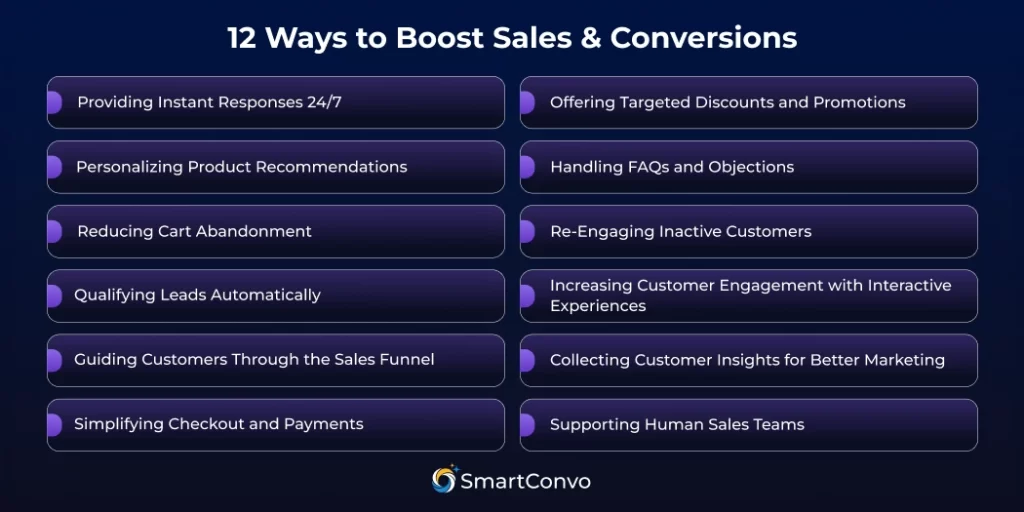
1. Providing Instant Responses 24/7
Imagine a customer lands on your site at midnight with a question about shipping. If they don’t get an answer, they might leave and never return. AI chatbots ensure that doesn’t happen by being available 24/7. They can instantly answer questions about delivery times, return policies, or product availability.
This kind of always-on customer service keeps potential buyers engaged and prevents missed sales opportunities, especially for businesses with global customers in different time zones.
2. Personalizing Product Recommendations
AI chatbots analyze customer data, including browsing history, cart items, and past purchases, to suggest personalized products.
For example:
- A chatbot on a clothing site may suggest accessories to go with a purchased dress.
- On a tech store, it could recommend laptop bags or headphones with a laptop purchase.
By making customers feel understood, chatbots not only improve the buying experience but also increase average order value through upselling and cross-selling.
3. Reducing Cart Abandonment
Cart abandonment is a major pain point in e-commerce, with rates averaging around 70%. AI chatbots help tackle this by:
- Sending friendly reminders to customers who leave items in their cart.
- Offering assistance if they face issues like payment errors.
- Providing discounts or free shipping incentives to encourage checkout.
These strategies recover lost revenue and convert hesitant shoppers into paying customers.
4. Qualifying Leads Automatically
Not every website visitor is ready to buy, but filtering them manually can waste time. AI chatbots can step in as smart lead qualifiers.
They ask targeted questions such as:
- “What’s your budget range?”
- “Are you looking to buy now or in the future?”
- “Which product features matter most to you?”
Based on responses, the chatbot categorizes leads as hot, warm, or cold. This ensures your sales team focuses on the right prospects, increasing efficiency and closing rates.
5. Guiding Customers Through the Sales Funnel
AI chatbots are excellent at providing contextual support at every stage of the funnel:
- TOFU (Top of Funnel): Educating new visitors with product information and answering FAQs.
- MOFU (Middle of Funnel): Offering comparisons, demos, or reviews to help decision-making.
- BOFU (Bottom of Funnel): Sharing discounts, free trials, or connecting customers to a live agent to seal the deal.
By reducing friction throughout the funnel, chatbots keep customers moving closer to conversion.
6. Simplifying Checkout and Payments
Many shoppers drop out during checkout because of complicated steps. AI chatbots simplify this process by:
- Guiding users step-by-step through checkout.
- Sharing quick payment links.
- Supporting multiple payment methods.
Some advanced chatbots even integrate with payment gateways, allowing customers to complete transactions within the chat window itself. This streamlined checkout reduces drop-offs and boosts conversions.
7. Offering Targeted Discounts and Promotions
AI chatbots can deliver personalized promotions based on user behavior. For instance:
- A chatbot might offer 10% off to a first-time visitor hesitating at checkout.
- Returning customers may receive loyalty discounts or “Buy 1 Get 1” offers.
These tailored incentives feel relevant rather than generic, which encourages customers to act quickly and finalize purchases.
8. Handling FAQs and Objections
Many buyers hesitate because of unanswered questions like:
- “What’s the return policy?”
- “Is there a warranty?”
- “Do you ship internationally?”
AI chatbots answer these queries instantly, removing doubts that could block a sale. By addressing objections in real time, they build customer confidence and drive conversions that might otherwise be lost.
9. Re-Engaging Inactive Customers
A customer who browsed your store last week but didn’t buy is still a potential lead. AI chatbots can send personalized follow-ups, such as:
- “Still thinking about this product? Here’s 10% off just for you!”
- “We’ve restocked the item you were looking at—grab it before it sells out.”
These reminders create urgency and encourage customers to return, improving long-term conversion rates.
10. Increasing Customer Engagement with Interactive Experiences
AI chatbots aren’t just functional—they’re engaging. They can:
- Share product quizzes to help customers choose.
- Tell stories about product features.
- Use GIFs, emojis, and conversational tones to make chats more enjoyable.
This interactive experience builds trust and makes customers feel connected to your brand, increasing the likelihood of purchase.
11. Collecting Customer Insights for Better Marketing
Every chatbot conversation provides valuable data. Businesses can track:
- Commonly asked questions.
- Popular products.
- Pain points causing drop-offs.
These insights are gold for marketing and sales teams. They can refine campaigns, improve product descriptions, and create targeted offers—leading to better conversions in the future.
12. Supporting Human Sales Teams
AI chatbots aren’t replacing humans; they’re empowering them. By taking over repetitive tasks like answering FAQs, booking appointments, or checking order status, chatbots free up sales reps to focus on high-value deals.
This partnership improves efficiency, reduces workload, and ensures sales teams spend their time where it matters most—closing deals and nurturing strong customer relationships.
Conclusion
AI chatbots are more than just digital assistants—they’re sales powerhouses. By handling everything from abandoned carts to lead qualification, they boost conversions while saving costs.
The 12 strategies we covered show how AI chatbots can transform your customer journey into a seamless, engaging, and profitable experience.
Frequently Asked Questions (FAQ)
Yes, by reducing cart abandonment, qualifying leads, and offering 24/7 support, chatbots consistently improve conversions.
They manage routine interactions well, but human reps are still crucial for complex negotiations.
E-commerce, SaaS, retail, travel, and finance benefit most, but any customer-facing business can use them.
Most businesses see measurable improvements within 2–3 months.
No—many affordable chatbot platforms are tailored for SMBs and startups.

With 8+ years of experience as a software engineer in the IT field, an Elite in Back-end development, DevOps, and Project & Team Management. Read more