
6 Signs Your Customer Support Needs an AI Chatbot

Written By : Shantilal Matariya

Published on : June 30, 2025

7 min read


Customer expectations have shifted—they want instant, 24/7 support across time zones and devices. But as startups scale, manual customer service often can’t keep up. That’s where AI chatbots step in. Able to handle up to 80% of routine queries and cut support costs by 90%, chatbots offer consistent, scalable support without the overhead. If your team is stretched thin, response times are slipping, or costs are rising, here are 6 signs it’s time to rethink your support strategy.
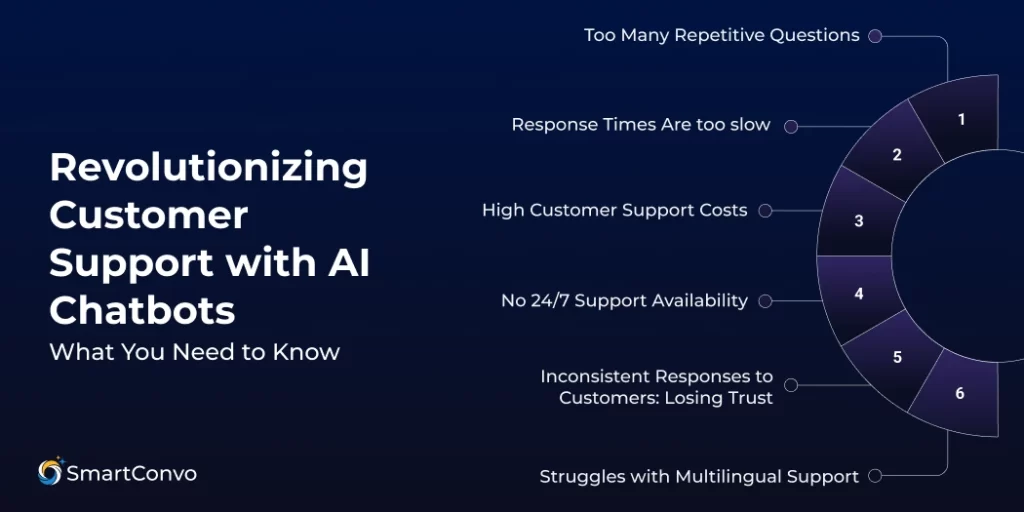
- Too Many Repetitive Questions: Chatbots answer common questions—like “Where’s my order?”—without help.
- Slow Response time: Customers hate waiting. Chatbots give instant answers, anytime.
- High Customer Support Costs: Hiring more agents is expensive. Chatbots do more for less.
- No 24/7 Support: Chatbots never sleep. They help customers even at midnight.
- Language Barriers: Chatbots can talk to customers in multiple languages instantly.
- Customers Are Unhappy: Faster, friendlier support means happier, more loyal customers.
Revolutionizing Customer Support with AI Chatbots: What You Need to Know
Sign #1: Too Many Repetitive Questions
If your support team spends most of its day answering the same basic questions—like “What’s your return policy?” or “When will my order ship?”—you’re not alone. Studies show that up to 80% of support queries are repetitive. This not only drains your team’s time and energy but also increases support costs and slows down response times.
AI chatbots like SmartConvo are built for exactly this. They instantly answer common questions about pricing, shipping, returns, and account details—accurately and consistently. That means no more inconsistent replies or agent fatigue from answering the same thing 50 times a day.
With chatbots handling the routine stuff, your human agents can focus on more complex, meaningful conversations that require empathy and critical thinking. Plus, AI learns and improves over time, updating FAQs without needing constant manual input. The result? Faster support, lower costs, and happier customers.
Sign #2: Response Times Are too slow
In today’s on-demand world, customers expect help now, not later. According to Zendesk, 60% of customers expect a reply within an hour, and nearly half want one in just 30 minutes. Some studies show that 75% of people expect a response within 5 minutes. If your support team can’t meet these expectations, you’re already falling behind.
Slow replies frustrate users, reduce trust, and lead to churn—especially if your competitors respond faster. Every delay is a lost opportunity to build loyalty or close a sale.
That’s where SmartConvo AI chatbots come in.
Chatbots can instantly answer common questions—like order status, refund policies, or basic troubleshooting—without any human delay. Unlike agents who can only handle one customer at a time, chatbots respond immediately, 24/7, to unlimited users.
Here’s the difference:
| Traditional Support | AI Chatbot Support |
|---|---|
| Delayed by hours or shifts | Replies instantly |
| Limited to business hours | Always available, 24/7 |
| Bottlenecks during high volume | Handles spikes with no delays |
| One chat per agent | Manages 100s at once |
AI doesn’t just speed up support—it transforms it. By reducing wait times, easing the load on your team, and keeping customers happy, chatbots turn slow support into a competitive edge.
No Credit Card Required | 14 days Free Trial
Build Your Chatbot
Sign #3: High Customer Support Costs
Scaling a customer support team can quickly become expensive. From hiring and training agents to managing tools, infrastructure, and after-hours staffing, the costs add up fast—especially for fast-growing startups. Traditional support operations often require:
- Salaries, benefits, and overhead for full-time agents
- Time-consuming onboarding and training cycles
- Licenses for CRM, helpdesk, and communication tools
- Office space, equipment, and IT support
- Additional costs for night shifts or multilingual teams
AI chatbots offer a smarter, leaner alternative. By automating common queries and handling multiple conversations at once, an AI chatbot to reduce customer service costs can minimize the need for large teams and manual workflows.
Here’s how the cost comparison stacks up:
| Support Category | Traditional Support | With AI Chatbots |
|---|---|---|
| After-Hours Coverage | Overtime or night shift pay | No extra cost—bots work 24/7 |
| Language Support | Multiple language-specific teams | Real-time translation via AI |
| Query Handling Capacity | One agent per chat | AI handles multiple chats simultaneously |
Solutions like SmartConvo AI have shown up to 90% cost reduction on routine support tasks. For startups under pressure to scale without ballooning expenses, AI chatbots provide a cost-efficient, high-performance path forward.
Sign #4: No 24/7 Support Availability
In today’s always-on world, customers expect help whenever they need it, not just during business hours. If your support is offline at night or on weekends, you risk losing sales, damaging trust, or pushing customers toward competitors. For global startups serving multiple time zones, delivering 24/7 support with human agents is expensive and difficult to scale.
That’s where AI chatbots shine. They work around the clock, instantly answering questions—even while your team is asleep. With a chatbot, you can offer seamless support worldwide without hiring night-shift staff or inflating costs. It’s a smart way to stay available, build trust, and grow globally.
Sign #5: Inconsistent Responses to Customers: Losing Trust
Delivering fast customer support is hard—but delivering consistent support is even harder. The reality? Most companies are falling short. Research shows only 23% of businesses provide consistent answers across just two channels, and a shocking 8% manage it across three. That means most customers get different answers depending on how—or when—they ask.
Inconsistent responses lead to big problems. Customers often have to repeat themselves or reach out multiple times just to get the right information. Support teams lose time correcting mistakes, and training new agents becomes chaotic without a clear process or source of truth.
It also impacts your brand. When customers receive conflicting answers, they start to question your reliability. In fact, 69% of companies fail to maintain consistency across channels, and many respond on only one platform—or not at all.
The result? Lost sales, slower conversions, and unhappy customers who are more likely to turn to a competitor that communicates better. If your support feels scattered, it’s a clear sign your team needs the consistency and structure that an AI chatbot can deliver.
Sign #6: Struggles with Multilingual Support
In today’s global market, language should never be a barrier—but for many startups, it still is. Studies show that 71% of customers prefer interacting in their native language, yet most companies fail to deliver consistent multilingual support. Why? Because traditional methods rely on hiring multilingual staff, managing shifts across time zones, and juggling inconsistent translations.
As your customer base grows internationally, so does the challenge. Without reliable language support, businesses risk frustrating users and losing sales. In fact, 60% of consumers are more likely to return to a site that speaks their language.
That’s where AI chatbots change the game.
| Aspect | Traditional Support | AI Chatbot Support |
|---|---|---|
| Language Coverage | Limited to team skills | Multiple languages instantly |
| Response Time | Delayed by availability | Instant replies |
| Cost per Language | High (more hires) | No added cost |
| Consistency | Varies per agent | Always consistent |
AI-powered chatbots like SmartConvo break language barriers at scale—no extra training, no extra cost.
AI Chatbots vs. Traditional Support: A Clear Comparison
Still wondering if AI chatbots are the right move for your customer support? Let’s break it down. Below is a side-by-side look at how AI-powered chatbots stack up against traditional support teams across key areas:
| Category | AI Chatbots | Traditional Support |
|---|---|---|
| Availability | 24/7 real-time support | Limited to working hours or shift teams |
| Response Speed | Instant replies in milliseconds | Often 24+ hours, especially during peak times |
| Cost Efficiency | Reduces up to 90% of routine support costs | High staffing, training, and overhead costs |
| Language Support | 80+ languages out of the box | Limited to agent fluency |
| Scalability | Handles unlimited conversations | Requires more agents to scale |
| Consistency | Delivers the same answer every time | Varies by agent knowledge and tone |
| Query Resolution | Solves 80% of FAQs without escalation | Depends heavily on individual agent skills |
| Data & Insights | Automatically collects and analyzes data | Manual tracking, often incomplete or delayed |
Here’s a standout stat: 71% of customers report faster response times when engaging with AI-powered solutions—and faster support means happier users.
Take SmartConvo for example. It automates up to 80% of customer inquiries while handing off complex cases to live agents when needed. The result? A smarter, hybrid support model that scales with your startup, reduces overhead, and keeps your customers coming back.
AI chatbots aren’t just an upgrade—they’re redefining what great customer support looks like.
Conclusion
If several of the signs above felt familiar, you’re not alone. Thousands of fast-growing startups are already turning to AI chatbots to reduce costs, improve customer retention, and deliver better user experiences. But it’s not just about automation—it’s about creating a scalable, human-like support system that evolves with your business and keeps your customers engaged at every stage.
Frequently Asked Questions (FAQ)
A chatbot that uses AI to answer customer queries automatically and instantly.
It can resolve up to 80% of routine customer questions without human help.
Yes, it works round-the-clock, regardless of time zones or holidays.
No, they support humans by handling repetitive tasks so agents focus on complex issues.

With 8+ years of experience as a software engineer in the IT field, an Elite in Back-end development, DevOps, and Project & Team Management. Read more