
AI Chatbot vs AI Agent: What’s the Difference?

Written By : Shantilal Matariya

Published on : July 28, 2025

8 min read


Using AI in your business is a smart move, but not all AI tools are the same.
Today’s customers expect fast, helpful, and personalized service. Over 80% of people want quicker replies, and almost 75% expect AI to understand their needs. If your tools aren’t keeping up, your customers will notice.
For years, AI chatbots have been used to answer common questions and save time. But now, a more advanced tool is here: the AI agent.
Understanding the difference between AI agents vs chatbots is crucial. Choosing the right solution in the AI Chatbot vs AI Agent can make a big difference. Pick the wrong one, and you might miss chances to impress your customers—or worse, frustrate them.
In this guide from SmartConvo, we’ll explain everything in simple terms:
- What are AI chatbots and AI agents
- How businesses use them in the real world
- Which one is right for your needs
By the end, you’ll know how each tool can help your business—and how they can even work together.
Let’s get started!
What are AI Chatbots?
An AI chatbot is a program that talks to users through text or voice, using advanced technology to understand and respond naturally. These bots use natural language processing (NLP) and machine learning to answer questions and have realistic conversations.
Modern AI chatbots are smarter than older rule-based ones, which followed strict scripts. Today’s bots can understand context, keep a conversation flowing, and adapt to users’ needs and preferences.
Here’s what makes AI chatbots special:
- Conversational Interface: They communicate through natural language, making interactions feel more human-like and intuitive for users.
- Smart Responses: Instead of using pre-written answers, they generate replies that match the situation.
- Learning Capabilities: They get better over time by analyzing past chats and user feedback.
- Multi-channel Deployment: These systems work on websites, mobile apps, social media, and messaging platforms.
For example, when you build an AI service chatbot, can answer common questions, process simple requests, and pass complex issues to a human. This helps businesses provide 24/7 support while saving time and money.
What are AI Agents?
An AI agent is a smarter form of artificial intelligence that can perform tasks and make decisions on its own to achieve specific goals. Unlike chatbots, which focus on conversations, AI agents take actions and complete complex tasks.
Here’s what makes AI agents special:
- Autonomous Decision-Making: They can analyze situations, weigh options, and make decisions without constant human oversight.
- Goal-Oriented: AI agents focus on specific goals and adjust their actions as situations change or new information becomes available.
- Interaction with Systems: They can use different systems, databases, and tools to get tasks done.
- Proactive Operation: Instead of just answering questions, AI agents can take actions or start processes based on set triggers or patterns they’ve learned..
- Handling Complex Tasks: They can manage complex tasks that involve working with multiple systems and people.
What is the difference between an AI agent and an AI chatbot?
The key difference between AI agents vs. AI chatbots lies in their capabilities—while chatbots focus on handling conversations, AI agents go beyond to perform tasks, make decisions, and execute actions
| Aspect | AI Chatbot | AI Agent |
|---|---|---|
| Task Complexity | Handles simple, scripted conversations or FAQs | Performs complex tasks, makes decisions, and can act autonomously |
| Context Awareness | Limited context; usually works per session | Maintains context across interactions; remembers user history |
| Learning Ability | Mostly rule-based or basic NLP; limited learning | Often uses Machine Learning (ML) to improve over time |
| Decision-Making | Follows pre-set flows or scripts | Makes decisions based on real-time data and goals |
| Autonomy Level | Reactive (responds to inputs) | Proactive (can initiate actions or alerts) |
| Integration Capability | Integrates with basic tools (CRM, calendars, APIs) | Integrates across systems (e.g., CRM, ERP, databases, tools) |
| Personalization | Generic responses based on keywords or intent | Personalized responses based on user profile and context |
| Cost | More affordable and scalable for basic use | Higher initial cost due to advanced capabilities |
| Deployment Time | Faster and easier to deploy | Takes longer to train, configure, and integrate |
Real-world Use Cases of AI Chatbot and AI Agent
Understanding how each works in real-life situations makes it easier to see the difference between AI chatbot vs AI agent. It also shows how businesses can use them effectively.
Use Cases of AI Chatbot

Customer Support: AI chatbots can handle common customer questions instantly— like order status, return policies, and product details. AI Chatbots quickly handle simple issues and pass more complicated ones to human agents.
Lead Generation: Marketing teams use chatbots to talk to website visitors, collect contact details, and find potential customers. Ai Chatbots feel natural and make it easy to gather useful information.
Content Recommendations: Media platforms use chatbots to recommend content based on what you like and watch. This creates a personalized experience for everyone.
Appointment Scheduling: AI chatbots help customers book, reschedule, or cancel appointments quickly—no need to call or wait. They connect to your calendar and can even send reminders, making things easier for both customers and staff.
Use Cases of AI Agents
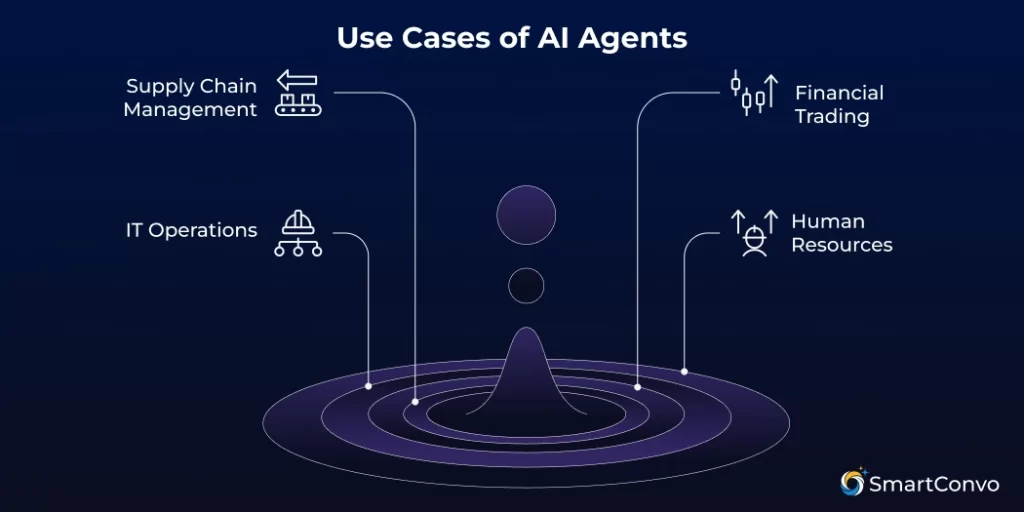
Supply Chain Management: Manufacturing companies use AI to keep track of inventory, predict changes in demand, place orders with suppliers automatically, and plan the best delivery routes, all without needing human help.
Financial Trading: Investment firms use AI to study the market, make trades based on set strategies, and adjust portfolios in real-time.
IT Operations: Tech companies use AI tools to track how systems are working, spot problems, fix simple issues automatically, and manage maintenance across different platforms.
Human Resources: Many Companies use AI tools to sort job applications, schedule interviews, assess candidates, and handle onboarding for new employees.
AI Chatbot vs AI Agent: Which One Do You Need?
Understanding the differences in AI Chatbot vs AI Agent technology can help you determine which solution fits your requirements best.
When to Choose an AI Chatbot:
Your main goal is to improve how you communicate with and support customers. Chatbots are great for handling lots of simple questions, giving instant answers, and staying connected with customers across different channels.
They’re also budget-friendly, with lower setup and maintenance costs compared to AI agents. If you want to automate customer interactions without dealing with complicated systems, chatbots are a smart choice.
Chatbots work best for businesses with simple communication needs, focusing on availability, consistency, and scalability.
When to Choose an AI Agent:
Your business workflows can be complex, requiring decisions and actions across different systems. AI agents can help by simplifying operations, reducing manual work, and managing tasks like data analysis and process coordination.
AI agents work best if your business has strong technology systems in place to support them. They’re especially useful for companies focused on improving efficiency and using automation to stay ahead of the competition.
If you’re ready to invest in advanced technology, AI agents can deliver big improvements in processes and help cut costs over time.
Will AI agents replace chatbots?
When it comes to the question of ai agent vs chatbot, the reality is that AI agents and chatbots work together more than they compete. Instead of replacing each other, they are evolving to specialize in different areas.
AI agents are getting smarter and can take over some chatbot tasks, especially when the conversation is part of a bigger job. In some cases, businesses are even using multi agent systems, where different AI agents work as a team to handle complex tasks. Still, AI chatbots are great for quick replies and helping customers right away.
In the future, we’ll see more systems that combine AI agents and chatbots. These systems will be able to hold natural conversations and handle complex tasks at the same time.
Businesses are likely to use both technologies wisely, choosing the right one for the right purpose, instead of seeing them as either-or options.
Conclusion
We hope this guide helped you clearly understand the difference between an AI agents and AI chatbots.
When comparing AI agent vs AI chatbot, it’s important to recognize that each serves unique purposes—while chatbots excel at handling simple, repetitive queries, AI agents are designed to manage more complex, context-driven tasks.
Whether you’re looking to answer quick questions or automate entire workflows, understanding the real difference between an AI chatbot vs AI agent is the first step to making smarter tech choices.
The best part? You don’t have to choose just one. With SmartConvo, you can combine the simplicity of a chatbot with the power of an agent—and give your customers the experience they truly deserve.
Frequently Asked Questions (FAQ)
AI agents and AI chatbots work well together—chatbots handle customers, while AI agents manage complex tasks.
Yes, AI agents handle complex tasks, while chatbots focus on simple, rule-based conversations.
Often, yes—agents offer more capabilities and need more resources to deploy effectively.
Yes, but chatbots may be easier to start with. Agents work better as needs grow.

With 8+ years of experience as a software engineer in the IT field, an Elite in Back-end development, DevOps, and Project & Team Management. Read more