
AI Chatbots vs Email Marketing: Which is Better in 2025?

Written By : Shantilal Matariya

Published on : July 17, 2025

7 min read


In today’s digital world, businesses need smart tools to connect with customers. Two popular options are AI chatbots and email marketing, which help brands engage and convert leads effectively.
But as we enter 2025, many business owners and marketers are asking: chatbot vs email marketing—which is better for business?
- AI chatbots provide instant, 24/7 customer support and can handle questions in real time.
- Email marketing remains a proven method with a high return on investment and personalized campaigns. Both have unique strengths but also limitations.
The right choice depends on your goals, audience, and resources. This article will compare AI chatbots vs email marketing based on their features, pros and cons, key differences, and best use cases.
By the end, you’ll know which strategy suits your business in 2025—or how combining both can deliver even better results.
Why AI Chatbots Are Better Than Email Marketing?
AI chatbots bring big advantages compared to traditional email marketing. The biggest one? They offer instant, 24/7 support and engagement. Unlike emails, which require waiting for a reply, chatbots respond within seconds, giving customers a better experience.
Modern chatbots are also great at personalization. They analyze user behavior in real-time and adjust conversations based on preferences, purchase history, and browsing habits. This goes beyond what email segmentation can do, showing the real power of chatbot and email marketing integration.
Chatbots don’t just handle marketing—they’re also great for lead qualification and customer service. They can smoothly switch from promoting products to solving customer issues, creating a seamless experience that email alone can’t provide.
Plus, chatbots can work with email marketing. They capture leads during chats and automatically add them to email nurture sequences. This combines the best of both tools, giving businesses a stronger, faster customer journey.
Pros and Cons of AI Chatbots and Email Marketing
Pros and cons of AI Chatbot
In this section, we’ll discuss the pros and cons of AI chatbots for businesses, focusing on how they can automate repetitive tasks and improve efficiency.
Pros:
- Quick responses to keep customers happy
- Available 24/7 without extra staffing costs
- Human-like conversations using natural language processing
- Easily fits into your customer service systems
- Collects and analyzes data in real time
- Boosts engagement during first customer interactions
Cons:
- Expensive and complicated to set up at first
- Struggles with handling detailed or complex questions
- Can frustrate customers with repetitive replies
- Needs regular updates and training to work well
- Lacks the personal touch some customers want
- Relies on strong technology and an internet connection
Pros and Cons of Email Marketing
Pros:
- Affordable with great results
- Builds strong, long-term customer relationships
- Provides detailed performance tracking
- Supports rich multimedia content
- Reaches a wide range of audiences
- Reliable with proven methods
Cons:
- Fewer people are opening emails because of crowded inboxes.
- Slow response times that can upset customers
- Emails might end up in spam folders.
- No real-time interaction with customers
- Needs regular content updates and list management
- Not ideal for quick customer support
Key Differences Between AI Chatbots and Email Marketing
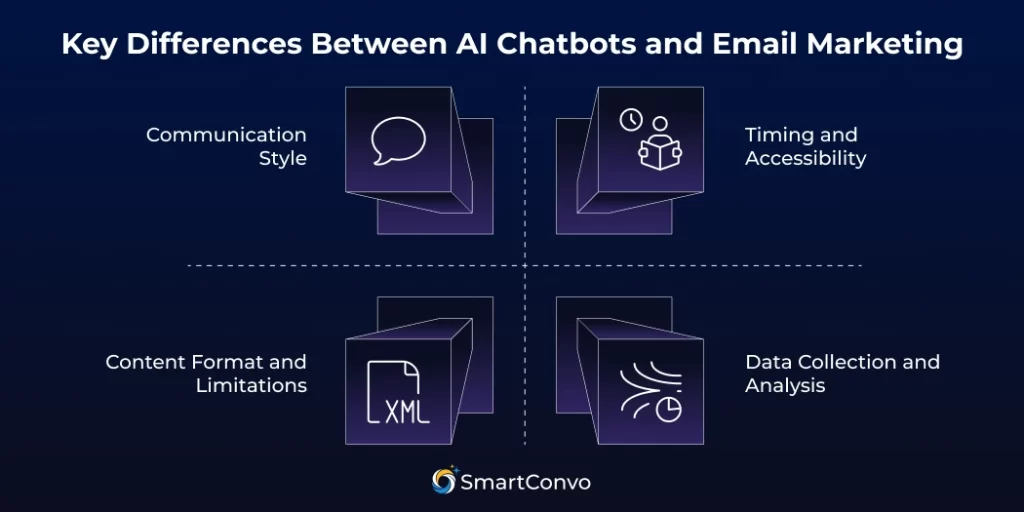
The main differences between these two approaches are how they communicate, their timing, and the user experience. Chatbots use real-time conversations that feel like talking to a person, while email marketing sends messages to many people at once, with responses that take longer.
Communication Style
Chatbots interact with users through two-way conversations that adjust to their responses.
Email marketing is mostly one-way but can include interactive features like polls and surveys.
Timing and Accessibility
Chatbots offer quick responses, creating expectations for instant results.
In contrast, email marketing works on a slower timeline, giving customers time to thoughtfully engage with the content. This difference shapes how people use and view each channel.
Data Collection and Analysis
Chatbots collect real-time data on user behavior and can instantly adjust their responses based on what the user does.
On the other hand, email marketing shows detailed analytics like clicks and conversion rates, but this data is reviewed and used later.
Content Format and Limitations
Email marketing lets you include videos, images, and detailed designs in your messages.
Chatbots, on the other hand, focus on shorter, conversational messages, but newer platforms are starting to offer more options.
Email marketing chatbots each have their strengths, but when combined, they can create a powerful communication strategy. Using a chatbot for email marketing allows businesses to engage customers more effectively, boosting interaction and delivering value seamlessly.
AI Chatbots vs Email Marketing: Top Use Cases
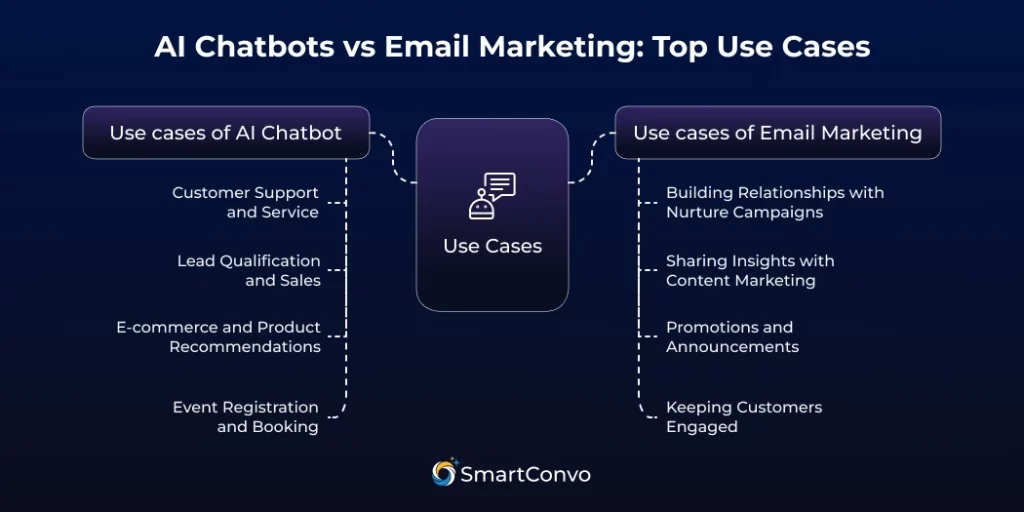
Use cases of AI Chatbot
Customer Support and Service
AI chatbots can quickly answer common questions, solve basic problems, and provide instant support. They’re especially helpful for businesses with a lot of customer inquiries or that work in different time zones.
Lead Qualification and Sales
Chatbots can chat with website visitors, ask simple questions to qualify leads, and send them to the right sales team. They often lead to higher conversion rates because of their interactive and personalized approach.
E-commerce and Product Recommendations
For online stores, chatbots can suggest products, help customers make decisions, and guide them through checkout. They work great for businesses with many products.
Event Registration and Booking
Chatbots make it easy to register for events, book appointments, or manage reservations. They provide instant confirmations and can answer basic questions.
Use cases of Email Marketing
Building Relationships with Nurture Campaigns
Email is perfect for building long-term relationships, sharing helpful content, and guiding prospects through longer sales cycles.
Sharing Insights with Content Marketing
If your goal is to share detailed insights or establish thought leadership, email gives you the space to deliver in-depth content.
Promotions and Announcements
Email is great for sending out promotions, product launches, and company news to large groups. Plus, you can track how well your campaign is performing.
Keeping Customers Engaged
For customer retention, loyalty programs, or post-purchase follow-ups, email is still the best and most effective choice.
AI Chatbots vs Email Marketing: Which Is Better?
The best approach depends on your business goals, what your customers want, and the resources available to you. Instead of choosing one or the other, many successful businesses combine both strategies to get the best results.
For Immediate Engagement and Support
If you want to provide fast customer support and chat with visitors in real-time, chatbots are the way to go. They grab attention, qualify leads, and help customers right away.
For Long-term Relationship Building
Email marketing is great for building long-term customer relationships, sharing detailed content, and staying in touch consistently.
For Startup Businesses
An AI chatbot for startups can provide quick customer support and qualify leads, all without needing extra staff.
But if your business has limited resources, email marketing might be a simpler and more affordable option to start with.
For Established Enterprises
Big businesses use both strategies: chatbots for customer service and email marketing to build relationships and keep customers coming back.
Conclusion
We hope you now understand the key differences between AI chatbots vs email marketing and how both can be incredibly useful for business startups. In 2025, the smartest strategies combine both, especially through chatbot email marketing.
In 2025, startups and growing brands can benefit greatly by combining the instant engagement of chatbots with the long-term value of email marketing. Each channel has unique strengths—when used together, they create a smart, scalable marketing strategy.
Ready to grow your business smarter?
Start integrating Smartconvo AI chatbots today to boost engagement, conversions, and ROI!
Frequently Asked Questions (FAQ)
No, chatbots can't replace email; both work best when used together strategically.
Chatbots collect leads; email nurtures them, creating a seamless customer journey.
Emails cost less upfront; chatbots cost more initially but have lower long-term expenses.
AI chatbots in 2025 will drive hyper-personalized, real-time marketing with smarter automation and insights.

With 8+ years of experience as a software engineer in the IT field, an Elite in Back-end development, DevOps, and Project & Team Management. Read more