
5 Common Fears About AI Chatbots (And How to Overcome Them)

Written By : Shantilal Matariya

Published on : July 30, 2025

7 min read


As AI chatbots become more integrated into customer service, it’s natural for customers and businesses to have reservations. A recent study found that 45% of customers still feel uneasy about how chatbots use their data. In data-sensitive industries like banking and finance, that number is even higher, with trust being a significant hurdle.
The question many still ask is: Is AI support risky? These concerns aren’t unfounded. Early AI bots often delivered robotic responses, misunderstood intent, or required complex setups. While the technology has evolved dramatically, the fears haven’t caught up with the facts, and that’s holding many businesses back from leveraging AI to its full potential.
In this article, we’ll explore five of the most common fears customers and business leaders have about AI chatbots—why they exist and, more importantly, how modern platforms like SmartConvo are built to address them directly.
With transparent AI practices, human-centered design, and smart automation, it’s possible to deliver AI-powered support that your customers can trust—and your team can rely on.
Let’s dive in.
The Rise of Generative AI in Chatbots
Generative AI is transforming customer service chatbots, elevating them from basic, scripted responders to dynamic, conversational assistants capable of delivering personalized, human-like experiences.
Unlike early chatbot models—which relied heavily on predefined flows and canned replies—generative AI allows bots to understand context, interpret nuance, and adapt their responses in real time. This evolution is made possible by major advancements in natural language processing (NLP), enabling AI to not just respond but to generate relevant, helpful, and conversational content on the fly.
As a result, today’s AI chatbots can handle more complex, open-ended queries that once required human intervention, leading to faster resolutions and smoother experiences, even during peak support hours.
Visualize a user on their phone, interacting with a chatbot that feels responsive but still imperfect, highlighting common fears like data privacy, impersonal responses, miscommunication, and a general lack of empathy.
But modern AI addresses these concerns head-on. One of the most powerful advancements is personalization: generative AI can now reflect a company’s unique voice and values, making every conversation feel on-brand. It can even adapt based on previous interactions, learning about the customer to deliver more relevant and context-aware support.
5 AI Chatbot Fears That Customers Have—And How to Overcome Them
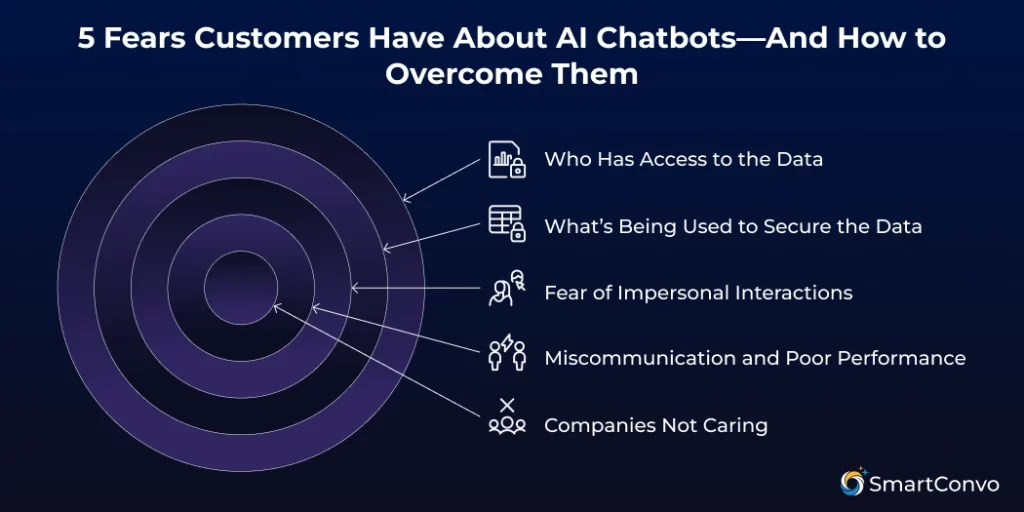
Fear #1: Who Has Access to the Data
When customers engage with AI chatbots—especially for support or service—data privacy becomes an immediate concern. They’re not just worried about sharing basic contact info; they’re thinking about how behavioral data, preferences, and personal context are collected, stored, and possibly misused.
AI chatbots often gather first-party (what users directly share) and zero-party data (what’s inferred from their behavior). While this allows for more personalized service, it also raises an important question: Who inside the company can see this data?
SmartConvo takes this seriously. All conversations are encrypted, and strict role-based access controls ensure that only authorized personnel can view sensitive information. Admins can monitor access, set permissions, and implement retention policies to meet internal and regulatory standards.
Trust begins with transparency. By clearly communicating data policies, minimizing unnecessary collection, and respecting consent, SmartConvo ensures your customers know their privacy is protected.
Fear #2: What’s Being Used to Secure the Data
It’s one thing to collect data responsibly, but what’s protecting it behind the scenes? As AI becomes more integrated into customer support, security fears rise—not just about internal use but about third-party risks, API vulnerabilities, and evolving threats.
Even if your company follows strict cybersecurity protocols, an AI chatbot can introduce new attack surfaces. Customers worry: Is my data being exposed through the model itself? Are third parties involved? How do I know it’s safe?
SmartConvo addresses this head-on. We use trusted, secure AI models and follow best-in-class encryption standards across all layers. Role-based access controls, audit trails, and regular security reviews keep data locked down. We also implement data redaction and minimization to meet GDPR and SOC2 compliance.
Security isn’t a one-time fix—it’s a continuous process. SmartConvo evolves with AI, so your data stays protected as threats evolve.
Fear #3: Fear of Impersonal Interactions
A major concern for customers is that AI chatbots will feel robotic, cold, or disconnected, turning what should be a helpful experience into a frustrating one. Without empathy or nuance, automation can feel like a wall, not a solution.
SmartConvo uses conversational AI powered by NLP and empathy-driven design to overcome this. It understands context, responds naturally, and adapts tone to match the customer’s emotional cues, making conversations feel human, not mechanical.
Even better, SmartConvo integrates a hybrid model: it handles routine tasks quickly and seamlessly escalates complex issues to human agents. That way, customers get fast answers when appropriate and real human care when it counts.
It’s not about replacing empathy—it’s about extending it through AI.
“Customers asked if it was a real person. That’s how smooth it sounded.”
With SmartConvo, conversations feel like conversations, not command prompts.
Fear #4: Miscommunication and Poor Performance
One of the biggest frustrations customers report is when a chatbot fails to understand them, leading to incorrect answers, repeated questions, or unresolved issues. This fear is especially strong among those who’ve had bad bot experiences in the past, where the tech simply couldn’t grasp what they meant.
SmartConvo is built to avoid those breakdowns. Powered by advanced NLP, it understands intent, tone, and even vague or unstructured queries. The platform is continuously updated with new training data, so performance improves over time—just like a seasoned support rep.
And if something does fall outside its scope? SmartConvo provides a clear, seamless path to a human agent—no awkward loops or dead ends.
Customers want to feel understood. SmartConvo makes sure they do.
Fear #5: Companies Not Caring
Some customers worry that AI chatbots are a sign that companies are cutting costs at the expense of care. To them, it may feel like a shift away from human connection—where support becomes transactional rather than thoughtful.
This fear is especially strong in sensitive contexts—billing issues, service complaints, or emotionally charged situations—where customers want to feel heard by a real person, not routed through a machine.
SmartConvo was built to enhance human support, not replace it. Our AI handles common questions instantly, freeing up your team to focus on the moments that matter. And when empathy or complexity is required, SmartConvo seamlessly hands off the conversation to a live agent.
It’s not about replacing care—it’s about scaling it, ethically and responsibly.
Conclusion
AI chatbots have come a long way—from rigid scripts to intelligent, human-like conversations. Still, it’s understandable that businesses and customers alike have concerns about trust, empathy, performance, and data security.
But as we’ve seen, these fears aren’t roadblocks—they’re signals. Signals that the AI chatbot implementation must be thoughtful, transparent, and built with people in mind.
SmartConvo was designed to address exactly these concerns. With secure data practices, empathy-driven AI, seamless human handoff, and ongoing optimization, it delivers automation without compromise.
If you’re curious—but cautious—about bringing AI into your support strategy, you’re not alone. And you don’t have to take the leap blindly.
Frequently Asked Questions (FAQ)
Yes—most use encrypted connections and follow strict data privacy regulations.
No—chatbots handle simple tasks, while humans manage complex or emotional issues.
Modern chatbots use NLP to understand context and respond more naturally than older bots.
Most systems offer an option to transfer you to a human agent for further help.
Many platforms offer easy, code-free setup options designed for small and large teams alike.
SmartConvo blends natural language AI with human handoff, making support fast, secure, and more human-like.

With 8+ years of experience as a software engineer in the IT field, an Elite in Back-end development, DevOps, and Project & Team Management. Read more