
How AI Chatbots Customer Intent Solves User Queries Faster

Written By : Shantilal Matariya

Published on : August 1, 2025

7 min read
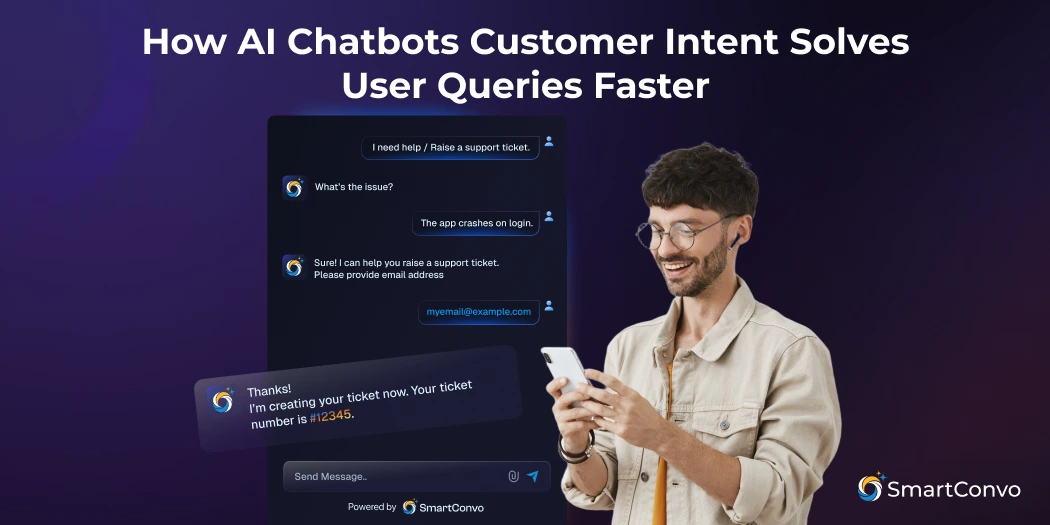


AI chatbots are designed to help customers quickly, but to do that well, they need to understand what the customer really wants. This is called customer intent.
As humans, we can easily understand different ways people ask the same thing. For example, “Where’s my order?” and “I want to check my delivery” mean the same thing. But for a chatbot, figuring that out isn’t so simple.
Many older chatbots follow pre-written scripts. They only respond based on fixed options and can get confused when someone types something unexpected. These bots don’t really understand the meaning behind the words—they just follow a flow.
Smarter AI chatbots are different. They use advanced technology to detect the AI chatbots customer intent behind a message. That means they know what the user is trying to do, even if the wording is new or complex.
In this article, we’ll look at how AI chatbots use customer intent to understand questions better and how that helps them solve user problems faster and more accurately.
Let’s get started!
What is customer intent in AI chatbots?
Customer intent refers to what a user wants to achieve when interacting with a chatbot. Instead of just focusing on the exact words a user types, AI systems examine the purpose behind the message to provide more accurate and better responses.
For example, if someone says, “I can’t log in,” the issue could be about a forgotten password, a locked account, technical problems, or even security concerns. Advanced AI chatbots understand these details and respond appropriately.
There are different types of customer intent:
- Informational intent: When customers want details about products, services, or policies.
- Transactional intent: When customers want to make a purchase, update an account, or process a return.
- Support intent: When customers need help with troubleshooting, complaints, or technical issues.
AI chatbots have come a long way. Older systems used simple rules and basic keyword matching. Today’s chatbots utilize advanced machine learning, enabling them to understand slang, abbreviations, emotional tone, and even anticipate follow-up questions.
Thanks to these improvements, modern AI chatbots can handle complicated questions, recognize urgency, and provide faster, more helpful support.
How AI Chatbots Detect and Understand Customer Intent
Intent detection uses artificial intelligence (AI) to figure out what customers mean when they send messages. Here’s how it works in simple terms:
1. Breaking down the message: AI chatbot uses Natural Language Processing (NLP) to analyze the text. It picks out important words, phrases, and clues to understand the message better.
2. Learning from past conversations: Machine learning compares the message to a big database of past interactions. It looks for patterns to predict what the customer wants.
3. Using context: AI considers things like past chats, customer account info, what page they’re on, or even the time of day to understand the message more accurately. For example, a question about “returns” means something different for a recent buyer than for someone just browsing.
4. Reading emotions: Sentiment analysis helps the system detect emotions like frustration or happiness. This lets it change its tone or decide if a human agent should step in to help.
5. Personalizing responses: The AI can recognize specific details like product names, account numbers, or services mentioned. That way, it can give tailored answers or take action without asking the customer to repeat information.
All of this happens in milliseconds, making responses quick, accurate, and helpful!
How AI Chatbots Solve Queries Faster Using Intent Detection
AI chatbots solve user queries faster by first understanding what the user really wants—this is called intent detection.
When a user types a message, the chatbot uses natural language processing (NLP) to read and understand it. Then, it identifies the user’s intent (like asking for a refund, tracking an order, or resetting a password). Once the intent is clear, the chatbot can instantly take the right action, such as giving information, asking follow-up questions, or completing a task.
This process saves time because:
- Users don’t have to repeat or rephrase their questions.
- The chatbot quickly responds with the most relevant answer.
- Actions like order tracking, form submissions, or updates happen automatically.
- No need to wait for a human agent in most cases.
In short, intent detection helps chatbots understand faster and act faster, making customer support quick, smooth, and more efficient.
Benefits of AI Chatbots Customer Intent for Query Resolution
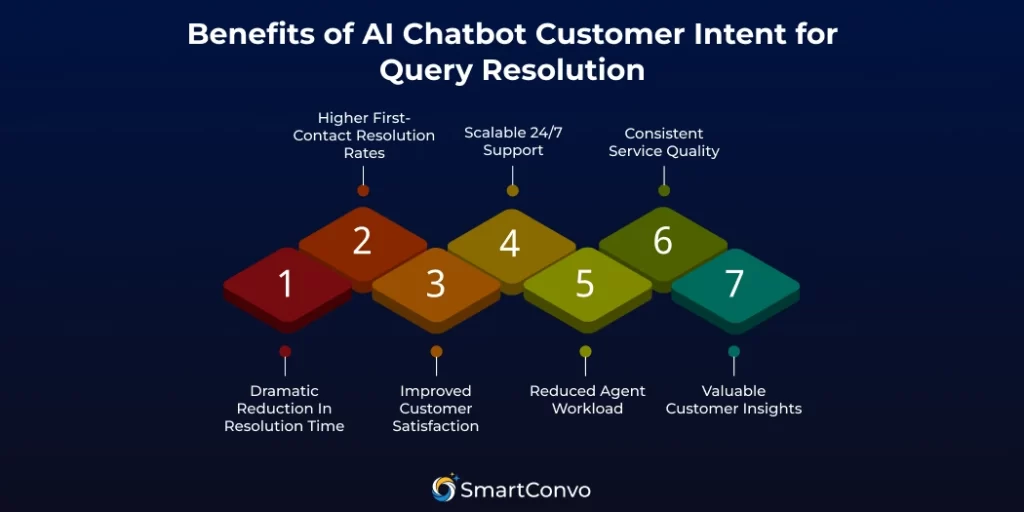
Recognizing chatbot intent helps improve customer service in clear and measurable ways. Here are some benefits of utilizing AI chatbots customer intent recognition for query resolution:
Dramatic Reduction in Resolution Time
Customers save time by explaining their needs once instead of going back and forth. What used to take multiple conversations can now be solved with a single, clear response.
Higher First-Contact Resolution Rates
Chatbots that understand user intent right away can give full solutions instead of partial answers that need more questions. This means fewer interactions to solve an issue.
Improved Customer Satisfaction
When customers feel understood right away, their experience gets better. AI intent recognition makes interactions feel more natural and helpful, like a real conversation.
Scalable 24/7 Support
Chatbots powered by intent can handle tough questions anytime, without needing a person to help. This lets businesses offer great support 24/7.
Reduced Agent Workload
These systems handle more questions on their own and give better information for tougher issues, allowing human agents to focus on solving complex problems that need their expertise.
Consistent Service Quality
Every customer gets the same great service and support, no matter when they reach out or which virtual agent helps them.
Valuable Customer Insights
Intent data shows what customers need by highlighting their common problems, favorite features, and areas where products or services could be improved.
Steps to Implement Customer Intent Detection in Your AI Chatbot
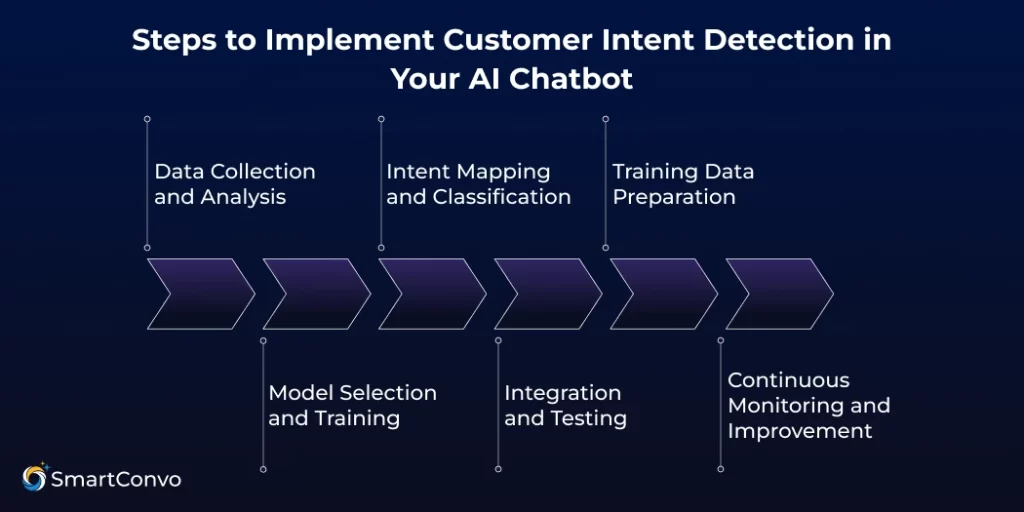
Successfully implementing AI chatbot customer intent detection requires careful planning and systematic execution across several key phases.
Step 1: Data Collection and Analysis
Start by collecting customer service data from all channels—chat logs, emails, phone calls, and support tickets. Review this data to find the most common customer requests and how people usually express them.
Look for patterns in the language they use, different ways they ask the same thing, and the context of their questions.
Step 2: Intent Mapping and Classification
Create a simple list of customer needs specific to your business. Start with broad groups like “billing,” “technical support,” and “product information.” Then, break these into smaller, more detailed needs.
Write down the different ways customers might ask for each, including similar words, slang, and common typos.
Step 3: Training Data Preparation
Create a strong training dataset by sorting real customer messages into categories based on your intent labels.
Include a variety of examples that show all the different ways customers might express each intent. This ensures your training data matches how your customers actually communicate.
Step 4: Model Selection and Training
Pick the right machine learning models for detecting intents. Pre-trained models can be a great option since you can adjust them to fit your data, but some businesses might need custom models. Use your dataset to train the models and set benchmarks to measure their performance.
Step 5: Integration and Testing
Add an AI chatbot to your website by integrating an intent detection system with your existing chatbot setup. Make sure it can recognize user intents accurately from the beginning. Test it thoroughly with real customer scenarios to ensure it works well and provides quality responses.
Step 6: Continuous Monitoring and Improvement
Keep an eye on how well your system understands customer intent, how happy customers are, and how quickly issues are resolved. Review conversations where the system didn’t get it right, and use what you learn to improve your models and update your training data.
Conclusion
We hope you now understand how AI chatbots customer intent helps solve user queries quickly and easily. Knowing what the user wants allows chatbots to give faster replies, better answers, and a smoother support experience. But understanding is just one part of the conversation.
Thanks to conversational AI, smart chatbots can also respond correctly, take action, and even provide customer support automation, making support faster and more efficient than ever.
Want to improve your customer support with a smart AI chatbot? Try Smartconvo today and make your chatbot understand your users better!
Frequently Asked Questions (FAQ)
AI intent detection systems achieve 85-95% accuracy, improving over time with more interactions and performance feedback.
AI systems support multilingual intent detection but need separate training and optimization for each language.
Yes, it handles routine queries, letting agents focus on complex or high-priority customer issues.
E-commerce, banking, healthcare, and SaaS greatly benefit from faster, smarter chatbot support.

With 8+ years of experience as a software engineer in the IT field, an Elite in Back-end development, DevOps, and Project & Team Management. Read more