
How Do AI Chatbots Qualify Leads Before Sales Calls

Written By : Shantilal Matariya

Published on : August 21, 2025

9 min read


Lead qualification is one of the most important steps in the sales process, helping businesses focus on prospects who are most likely to convert. Traditionally, sales teams had to manually close leads, often spending hours chasing unqualified prospects. This slowed the process and left sales reps with less time for high-value opportunities.
The rise of AI has changed this completely. A chatbot for lead qualification now acts as the first point of contact, engaging prospects instantly and asking the right pre-qualification questions. AI Chatbots collect key details like budget, needs, buying intent, and timeline to decide if a lead should go to the sales team.
So, how do AI chatbots qualify leads? By combining automation with intelligence, they can score leads, segment them into marketing- or sales-ready groups, and even route them to the right representative. What’s more, chatbots to qualify leads work 24/7, ensuring no opportunity is missed and that every interaction feels quick and personalized.
In short, AI chatbots save time, improve accuracy, and create a smoother path from first contact to sales call—helping businesses convert more with less effort.
What is AI Chatbot Lead Qualification?
AI chatbot lead qualification helps evaluate potential customers before they reach your sales team. Using AI and Natural Language Processing (NLP) in AI chatbots, they gather key details like buying intent, budget, timeline, and decision-making authority.
A lead qualification chatbot evaluates prospects using predefined criteria such as budget, needs, and decision-making authority, ensuring only high-quality leads move forward.
Here’s how it works: when someone visits your website or interacts with your digital channels, the AI chatbot starts a conversation based on their behavior. Through simple questions, it gathers key information while sharing helpful resources or solutions.
Modern AI chatbots for lead qualification get smarter over time. By learning from past interactions, they refine their questions and align with your industry’s lead-scoring system. This makes them increasingly accurate and effective.
These chatbots easily connect with your existing sales and marketing tools. Once a lead is qualified, the information goes straight into your CRM, complete with a summary of their needs, concerns, and preferences.
How AI Chatbots Qualify Leads?
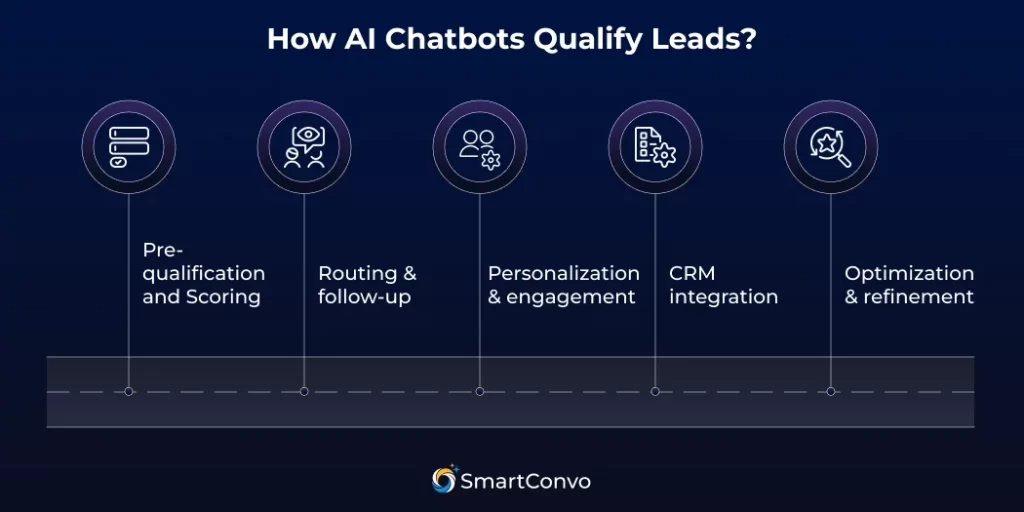
Many businesses wonder how do chatbots qualify leads? Essentially, they start by assessing basic prospect information, scoring responses, and determining readiness before routing leads to the right sales rep.
Pre-qualification and Scoring
The lead qualification process starts by quickly checking if a prospect is a good fit before diving into details. AI chatbots handle this step by analyzing basic prospect information to decide whether to move forward or redirect them.
Pre-qualification focuses on factors like company size, industry, job role, and needs. For B2B, this could include employee count, revenue, tools, or decision-making authority. For B2C, it might cover budget, needs, or timeline.
Chatbots score prospect responses to measure conversion potential. High scores indicate strong potential, like immediate needs or the right budget, while low scores suggest a weaker fit.
Routing and Follow-up
Qualified leads need to be routed quickly and correctly to boost conversion rates. AI chatbots work with CRM systems and sales tools to automatically assign leads based on their scores, location, product interests, or the availability of sales reps.
High-scoring leads—ready to buy with a budget and decision-making power—should go straight to a sales rep. The system checks team calendars to connect them immediately or schedule a callback based on the lead’s preferences.
The routing process factors in the lead’s source, qualifications, and the sales team’s workload for a smooth experience and better conversions. Follow-ups adjust to prospect responses. Ready-to-act leads get frequent, multi-channel follow-ups, while long-term leads enter nurturing campaigns to stay engaged.
Personalization and Engagement
SmartConvo systems deliver personalized, human-like interactions at the speed of automation. Conversations begin with tailored openers based on how prospects found your company, the pages they’ve visited, or the content they’ve accessed.
AI chatbots tailor language and examples for each prospect. Healthcare prospects get industry terms, while manufacturing prospects see relevant case studies. This keeps them engaged and shows your company understands their needs.
Personalization also includes content recommendations. As prospects share their needs, chatbots quickly offer resources like whitepapers, case studies, demos, or pricing. This targeted support improves their experience and keeps the process moving.
CRM Integration
Seamless CRM integration simplifies lead management and keeps your sales process smooth. AI chatbots connect with platforms like Salesforce, HubSpot, Pipedrive, and Microsoft Dynamics.
Here’s how integration helps:
- Automatically create leads, generate opportunities, assign tasks, and log activities.
- When a lead is qualified, their details (like scores, chat transcripts, and next steps) are added to your CRM within minutes.
Advanced integrations let chatbots use CRM data to personalize conversations, avoiding repeated questions and creating a smoother experience for returning prospects or customers.
Optimization and Refinement
Successful AI chatbot lead qualification is not static. AI-powered systems should include analytics to track how well conversations go, how many prospects are qualified, conversion rates, and customer satisfaction.
Review chat transcripts to refine questions, address objections, and update lead qualification criteria. Identify patterns in successful vs. unsuccessful chats and adjust your approach.
A/B testing can help figure out what works best. This could include trying different conversation starters, question sequences, follow-up timing, or content suggestions to improve results.
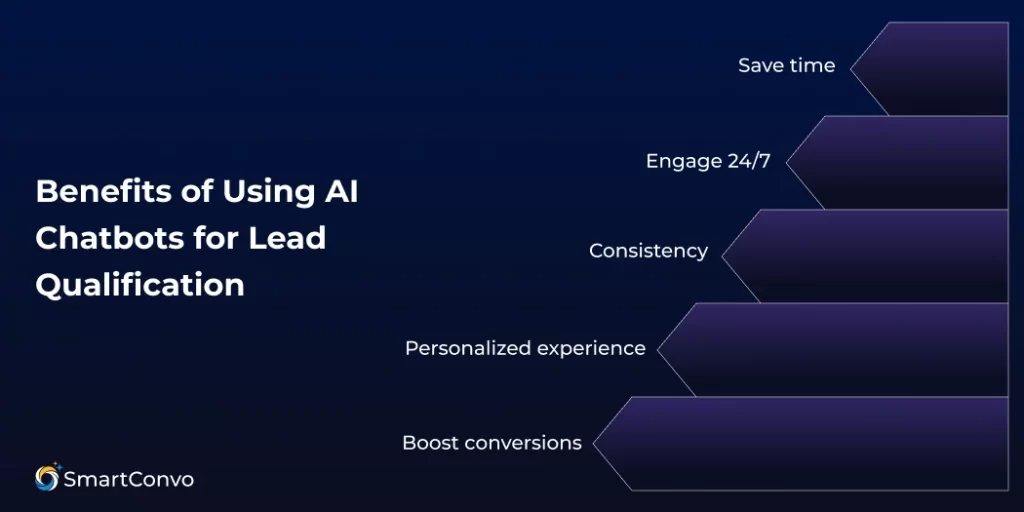
Benefits of Using AI Chatbots for Lead Qualification
Save Time
Sales reps typically spend 30–40% of their time on research and admin tasks. By using AI Chatbots for Sales, especially for sales call preparation, businesses cut down wasted time on unqualified leads. Instead of starting from scratch, reps receive ready-made prospect profiles with key details, allowing them to focus on building stronger customer relationships and closing deals faster.
Traditionally, lead qualification takes time: a prospect fills out a form, gets a generic email, and eventually talks to a sales rep who has to start from scratch to understand their needs. This process can take days or weeks, causing the prospect to lose interest or choose a competitor.
Engage 24/7
Business opportunities don’t stick to regular office hours. In fact, 67% of B2B buyers do their research after hours, and 42% expect quick replies no matter the time. AI chatbots solve this by offering 24/7 support—always available, never taking breaks, and never missing a chance to engage.
This is ideal for companies in global markets or targeting busy professionals who browse at night or on weekends. If a prospect finds your solution at 11 PM on Saturday, they can get answers immediately instead of waiting until Monday.
Consistency
Human-led lead qualification varies by skills, experience, or even mood. This inconsistency makes processes harder to optimize. Chatbots to qualify leads eliminate this issue by applying the same questions, scoring system, and brand messaging every time.
Chatbots also maintain consistent brand messaging. They share your company’s values, handle objections, and highlight key benefits using approved language, ensuring prospects get accurate and on-brand information during their first interactions.
Personalized Experience
AI chatbots, supported by AI agents, offer highly personalized experiences that can be as effective as human interactions. They use data like site behavior, past conversations, and real-time responses to create tailored interactions.
Personalization begins with unique openers. For instance, visitors from ads see interest-based messages, while product page visitors get questions tied to what they viewed. Chatbots adjust language, examples, and advice based on the prospect’s industry, company size, or challenges.
Boost Conversions
AI chatbots are great at improving lead conversion rates, often boosting them by 25-40% within six months. Here’s how they do it:
- Better lead qualification: Sales teams can focus on customers who are ready to buy.
- Faster responses: Quick answers keep customers from turning to competitors.
- Personalized experiences: Tailored conversations build stronger connections and boost sales.
Chatbots are great at re-engaging prospects who drop off. If someone doesn’t finish a conversation, the chatbot can automatically follow up to bring them back.
Implementing AI Chatbots for Lead Qualification
1. Align with Your Sales Process
- Ensure your chatbot matches your sales process and customer journey.
- Make sure it fits your tech stack and supports sales automation.
2. Define Lead Qualification Criteria
- Separate leads into MQLs (Marketing Qualified Leads) and SQLs (Sales Qualified Leads).
- Use historical data to identify factors that drive successful conversions.
3. Audit Your Current Process
- Review your lead qualification process to spot issues or gaps.
- Document key discovery questions, common objections, and success criteria.
4. Choose Strategic Trigger Points
- Deploy chatbots on high-intent pages such as:
- Landing pages
- Product pages
- Pricing sections
- Contact page
- Engage prospects when they are actively looking for information.
5. Design Effective Conversation Flows
- Start with broad, engaging questions to spark interaction.
- Narrow down responses to collect critical qualification data.
- Use branching logic to personalize conversations based on user answers.
Future of Lead Qualification with AI Chatbots
AI technology is making chatbots smarter and more effective for qualifying leads. Here’s how it’s improving:
- Human-like conversations: Chatbots now better understand and respond naturally, making chats feel like real conversations.
- Better predictions: Predictive analytics helps chatbots identify leads, the best time to reach out, and key decision factors.
- Sales integration: Chatbots handle lead qualification while sales teams focus on relationships, even assisting with contracts and account management.
- Voice-enabled chatbots: Using voice tech, chatbots can manage calls, smart speakers, and voice apps for talking over typing.
- Personalized interactions: Chatbots leverage data to create tailored conversations addressing specific prospect needs.
These improvements are making chatbots essential tools for businesses, combining automation with a personal touch.
Conclusion
To succeed with chatbot lead qualification, focus on continuous improvement. Combine advanced AI with a clear understanding of your customers, their buying journey, and your sales process. Regular testing and updates will keep your chatbot effective as your business and market evolve.
AI-powered lead qualifying chatbot systems get better over time as they learn from interactions, draw insights from your knowledge base, and fine-tune their approach. Businesses that adopt these systems early will gain a competitive edge that’s hard for others to catch up to.
Start by reviewing your current lead qualification process and look for areas where AI chatbots can help. Test it out on high-traffic pages or key points where customers convert, then expand once you see results.
The future of lead qualification is about blending AI efficiency with human relationship-building. By adding chatbots to your process, your sales team can focus on leads who are ready to become customers, saving time and boosting results.
Frequently Asked Questions (FAQ)
Lead qualification is the process of identifying prospects most likely to convert into paying customers.
AI chatbots ask key questions, score responses, and filter prospects to ensure only qualified leads reach sales reps.
Chatbots save time by automating lead screening, improving accuracy, and ensuring sales teams focus on high-quality leads.
They pre-qualify prospects, gather data, and ensure reps spend calls with leads who are ready to buy.
Yes, modern chatbots use AI and data to personalize conversations and build stronger engagement with prospects.

With 8+ years of experience as a software engineer in the IT field, an Elite in Back-end development, DevOps, and Project & Team Management. Read more