
What Is CSAT Score & How to Boost It Using AI Chatbots

Written By : Shantilal Matariya

Published on : August 5, 2025

8 min read


When it comes to building customer loyalty and delivering standout experiences, your CSAT score says more than any marketing campaign ever could.
CSAT, or Customer Satisfaction Score, is a key performance metric that measures how satisfied your customers are after interacting with your business, typically after a support conversation, purchase, or service touchpoint. A high CSAT score means happier customers, stronger retention, and higher lifetime value. A low one? It may signal inconsistent service, long wait times, or missed expectations.
But as customer expectations increase and support teams feel the pressure to do more with less, maintaining high satisfaction levels has become a growing challenge, especially for SaaS, e-commerce, and fast-scaling startups.
That’s where AI chatbots come in.
In this blog, we’ll break down:
- What a CSAT score is and how it’s calculated
- Why CSAT is one of the most important customer satisfaction metrics to track
- The most common reasons businesses struggle to improve CSAT
- How AI-powered chatbots like SmartConvo can dramatically improve your CSAT score by delivering fast, consistent, and personalized support—24/7
Whether you’re a customer support manager, CX strategist, or operations lead, this guide will help you understand how to transform your support experience with AI automation while boosting customer satisfaction without increasing headcount.
What Is a CSAT Score and How Is It Calculated?
The Customer Satisfaction Score—commonly known as CSAT—is a key performance metric used to gauge how satisfied customers are with a specific interaction, product, or service. It’s one of the simplest and most effective ways to measure customer sentiment in real time.
Most often, CSAT is measured by asking customers a straightforward question immediately after an interaction, such as:
“How satisfied were you with your experience today?”
Customers then respond using a predefined scale, usually from 1 to 5, where:
- 1 = Very dissatisfied
- 2 = Dissatisfied
- 3 = Neutral
- 4 = Satisfied
- 5 = Very satisfied
From there, CSAT is calculated using the Top-2-Box method:
CSAT (%) = (Number of “Satisfied” and “Very Satisfied” responses ÷ Total responses) × 100
For example, if 80 out of 100 customers select 4 or 5 on the scale, your CSAT score would be 80%.
Alternatively, some businesses use a Composite CSAT Score, which averages all numerical responses. If you received survey ratings of 5, 3, 5, 4, 2, 5, 5, and 4, your average CSAT would be 4.12 out of 5.
Both methods are useful depending on your goals. Top-2-Box is great for identifying satisfied users quickly, while the composite method gives a nuanced view of overall sentiment.
When and how are CSAT surveys sent?
- Post-chat or post-ticket closure in support workflows
- After product purchases or service delivery
- Via email, in-app pop-ups, or chatbot interactions
What’s considered a “good” CSAT score?
- 75% and above is generally considered strong
- 85–90% is considered excellent or world-class
- SaaS and e-commerce support teams typically aim for 85%+ to remain competitive
By consistently tracking your CSAT score, you gain real-time insight into the health of your customer experience and uncover where to focus efforts for improvement. And as we’ll explore next, AI chatbots like SmartConvo can play a powerful role in helping you maintain and grow that score.
Common Barriers to High CSAT Scores
Despite good intentions, many startups struggle with customer satisfaction due to resource constraints and scaling challenges. The most common barriers include:
- Response Time Issues: Customers expect immediate answers, but small teams can’t provide 24/7 support. Long wait times lead to frustrated customers and lower satisfaction scores.
- Inconsistent Service Quality: As your team grows, maintaining consistent service quality becomes challenging. Different team members may handle similar issues differently, creating confusion and frustration.
- Limited Availability: Your customers operate across different time zones and schedules, but your support team likely works standard business hours. This gap creates natural friction points.
- Repetitive Query Overload: AI chatbots for customer Support teams spend significant time answering the same basic questions repeatedly, leaving less time for complex issues that truly require human expertise.
- Scaling Challenges: Rapid growth often outpaces your ability to hire and train new support staff, leading to overwhelmed teams and declining service quality.
These barriers aren’t unique to any industry—whether you’re running an e-commerce platform, SaaS product, or service-based business, the fundamental challenges remain similar.
What Is a CSAT Score?
CSAT (Customer Satisfaction Score) is a metric that measures how satisfied customers are with a particular interaction, product, or service.
It’s typically collected through a simple survey question like:
“How satisfied were you with your experience today?”
Customers respond on a scale, usually 1 to 5, where 1 means very dissatisfied and 5 means very satisfied. The CSAT score is then calculated as:
CSAT = (Number of satisfied responses / Total responses) × 100
For example, if 80 out of 100 customers say they were satisfied (rated 4 or 5), your CSAT score would be 80%.
What’s a good CSAT score?
- Above 75% is generally considered strong.
- 85–90% is considered world-class.
- Benchmarks vary by industry—support teams in SaaS typically aim for 85% or higher.
How Do You Boost CSAT Scores Using AI Chatbots?
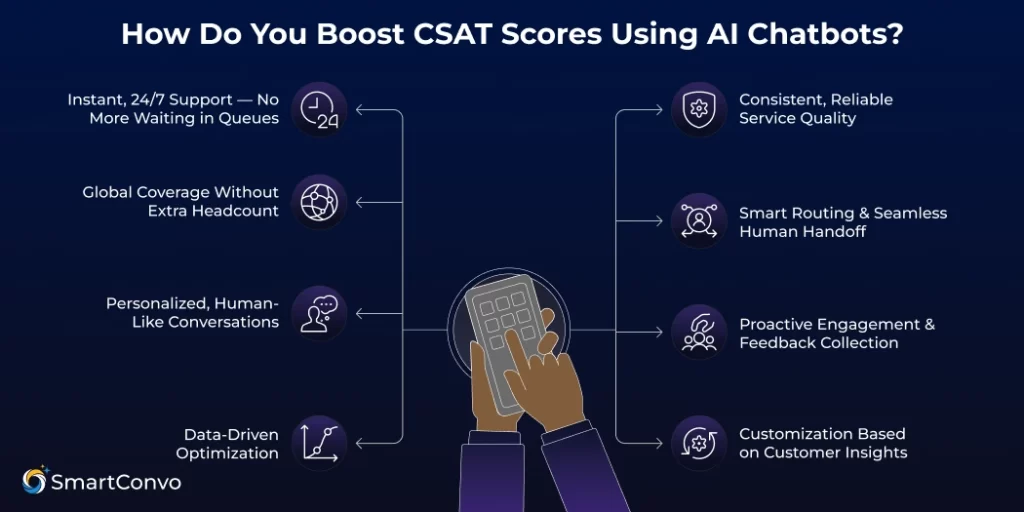
Boosting your CSAT score isn’t just about faster replies—it’s about delivering consistent, meaningful, and frictionless customer experiences at scale. That’s where AI chatbots like SmartConvo step in. Powered by natural language understanding and automation, SmartConvo’s chatbot enhances every touchpoint in the customer journey, driving higher satisfaction without overwhelming your support team.
Here’s how SmartConvo helps you increase your CSAT score:
1. Instant, 24/7 Support — No More Waiting in Queues
AI chatbots like SmartConvo respond to customer queries instantly, anytime, day or night. Whether it’s a password reset or a product inquiry, there’s no more waiting in long queues or getting stuck on hold. This immediate assistance reduces support response time and gives customers the fast support they expect, helping you lift CSAT scores by 10–15 points without adding extra staff.
2. Consistent, Reliable Service Quality
Human agents vary in tone, knowledge, and accuracy, but SmartConvo delivers the same high-quality responses every time. It uses structured flows and AI training to maintain consistency across conversations, ensuring your customers get clear, helpful answers, no matter when or how they reach out. This consistency builds trust and sets reliable service expectations that drive satisfaction.
3. Global Coverage Without Extra Headcount
SmartConvo operates around the clock across time zones—no breaks, no downtime. This gives your business global support reach without expanding your team. Whether a user is in New York or New Delhi, they’ll get instant help on their schedule. For startups or lean teams, this always-on capability unlocks significant improvements in customer experience and helps increase CSAT on a global scale.
4. Smart Routing & Seamless Human Handoff
Not every issue can—or should—be handled by a bot. SmartConvo identifies when a human agent is needed and smoothly transfers the conversation with full context intact. This ensures the customer doesn’t have to repeat themselves and receives the right support at the right time. Intelligent escalation like this makes customers feel heard and supported, leading to higher satisfaction ratings.
5. Personalized, Human-Like Conversations
With NLP, SmartConvo can understand tone, context, and customer intent. It personalizes conversations by referencing names, past purchases, and preferred languages. You can even configure its tone and style to match your brand. This level of personalization creates an experience that feels human—without requiring a live agent—boosting both engagement and CSAT scores.
6. Proactive Engagement & Feedback Collection
SmartConvo doesn’t just wait to be contacted—it proactively engages users with greetings, updates, or helpful suggestions. At the end of each interaction, it can automatically request CSAT feedback, letting you capture real-time insights without needing manual surveys. This proactive approach helps you detect issues early and continuously improve the customer experience.
7. Data-Driven Optimization
Every interaction with SmartConvo generates data about resolution rates, common pain points, and satisfaction trends. These insights help you fine-tune your chatbot and support processes. Track KPIs like query deflection rate or time saved per session, and use that data to reduce friction and improve satisfaction across the board—turning your chatbot into a CSAT growth engine.
8. Customization Based on Customer Insights
SmartConvo can tailor chatbot flows based on CRM data and past behavior, like showing product suggestions based on purchase history or prioritizing VIP customers. These micro-personalizations make users feel known and valued, not just processed. Customized experiences drive higher satisfaction because customers see you’re not treating them like just another ticket.
Conclusion
Customer satisfaction isn’t just a feel-good metric—it’s a strategic asset that directly impacts retention, referrals, and revenue growth. CSAT scores offer a clear, actionable snapshot of how well your business meets customer expectations. But to consistently achieve high CSAT, especially at scale, you need more than just great service—you need smart automation.
That’s where AI chatbots come in. By delivering instant support, personalized interactions, and 24/7 availability, chatbots like SmartConvo help you boost CSAT scores while reducing operational strain on your team. More than just a support tool, they serve as a growth lever—creating better experiences, stronger loyalty, and long-term business success.
Ready to take your CSAT to the next level? Let your chatbot lead the way.
Frequently Asked Questions (FAQ)
CSAT measures customer satisfaction based on post-interaction feedback, usually on a 1–5 or 1–10 scale.
Divide the number of satisfied responses (ratings 4–5) by total responses, then multiply by 100 for a percentage.
A score above 75% is strong, while 85–90% is considered excellent or world-class across most industries.
Chatbots provide instant, 24/7 support, reduce wait times, and ensure consistent customer service at scale.
Yes, chatbots can trigger surveys after interactions, helping capture feedback quickly and boost response rates.

With 8+ years of experience as a software engineer in the IT field, an Elite in Back-end development, DevOps, and Project & Team Management. Read more