
What is an AI Chatbot and Why Does Your Business Need One?

Written By : Shantilal Matariya

Published on : June 19, 2025

9 min read


An AI chatbot meaning can be understood as a software application that uses artificial intelligence (AI) to simulate human-like conversations with users.
Customers today expect instant, personalized, and accurate responses—available 24/7. So AI chatbots can understand natural language, process user input, and generate meaningful responses in real time.
Whether you’re a startup founder scaling customer support or a CTO automating internal processes, AI chatbots are rapidly reshaping how businesses operate across customer service, e-commerce, education, SaaS, healthcare, logistics, and beyond.
In this blog, we’ll walk you through:
- What is a AI chatbot (and how do they differ from rule-based bots)
- How they work behind the scenes
- Business benefits for tech-forward startups
- Industry-specific use cases
- How to get started the smart way
What is an AI Chatbot?
An AI chatbot leverages technologies such as Natural Language Processing (NLP), machine learning (ML), and sometimes large language models (LLMs) like OpenAI’s GPT to:
- Understand user queries (text or voice),
- Interpret the intent,
- Generate accurate, context-aware responses.
Unlike rule-based bots that follow pre-set commands or scripts, AI chatbots learn from data and interactions to improve over time.
In simple terms, what is AI chatbot? It’s like hiring a 24/7 digital team member that can handle queries, complete tasks, and even learn over time.
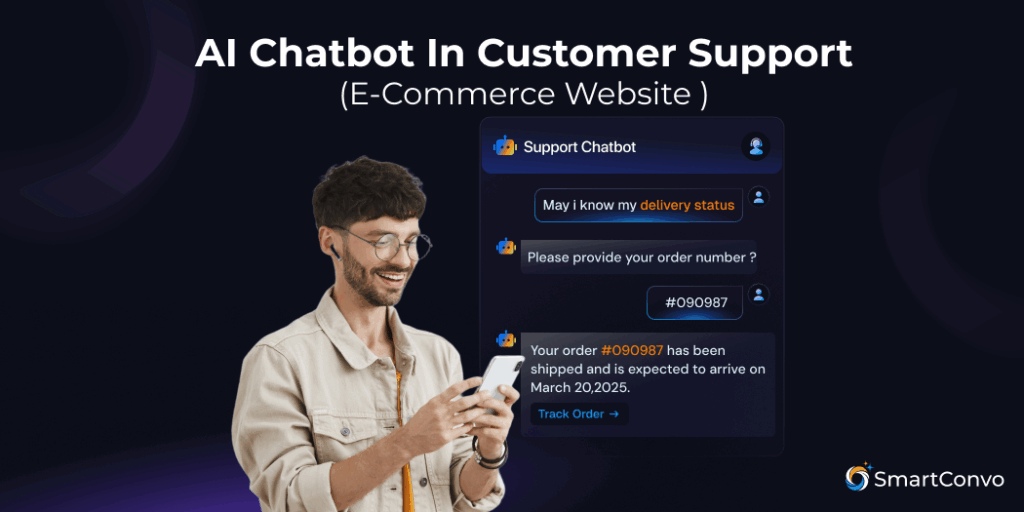
Below is a perfect real-time example of an AI based chatbot for Customer Support (E-commerce Website) in action — providing fast, intelligent, 24/7 support without needing a human agent.
How Do AI Chatbots Work? (Tech Breakdown for CTOs)
AI chatbots follow a multi-step process:
1. Input Processing
- The chatbot receives a message via text or voice.
- Natural Language Processing (NLP) is used to understand the grammar, meaning, and context of user queries
2. Intent Recognition
- The chatbot identifies what the user wants (e.g., booking a flight, asking a question, tracking an order, refund request).
- Machine Learning (ML) enables the chatbot to learn from past conversations, user behavior, and feedback, making it smarter over time without being explicitly reprogrammed.
3. Response Generation
- Modern AI chatbots are powered by LLMs (like OpenAI’s GPT or Google’s Gemini). These models can generate human-like responses, solve queries, and even handle nuanced conversations.
4. Backend Integrations
For functional use (e.g., fetching order status, booking meetings), chatbots integrate with:
- CRM tools (e.g., Salesforce, HubSpot)
- E-commerce platforms (e.g., Shopify, WooCommerce)
- APIs & internal databases
5. Feedback Loops
Chatbots can be trained continuously through reinforcement learning, fine-tuning responses based on performance metrics like:
- CSAT (Customer Satisfaction Score)
- Resolution time
- Drop-off rates
Types of AI chatbots

Not every AI chatbot is created equal. Some are designed to handle basic user requests, while others are built with deep conversational intelligence and task automation in mind. For startup founders and CTOs evaluating AI chatbot solutions, it’s essential to understand the various types and their strategic roles in business workflows.
Here’s a breakdown of the most common types of AI chatbots, along with their ideal use cases:
1. Transactional AI Chatbots
These task-specific bots help with straightforward interactions like checking order status, booking appointments, or updating shipping details.
Example: An e-commerce AI chatbot like SmartConvo AI Chatbot that allows customers to track orders or request a return directly via chat.
2. Conversational AI Chatbots
These bots use natural language understanding to engage in human-like conversations. They’re ideal for customer-facing roles, where context, tone, and flow matter for better user experiences.
Example: A SaaS chatbot that walks new users through the product onboarding with personalized, real-time guidance.
3. Decision Support AI Chatbots
These virtual advisors help users make informed choices by presenting relevant data and potential outcomes. Commonly used in industries like finance, healthcare, and enterprise SaaS.
Example: A financial planning bot that helps users choose investment plans based on risk preferences and budget.
4. Workflow Automation AI Chatbots
These bots handle repetitive tasks within business processes. They interact through conversation to gather inputs, make decisions, and trigger actions inside other tools like CRMs, ERPs, or ticketing systems.
Example: An internal HR chatbot that automates leave requests, approvals, and updates employee records instantly.
5. Informational AI Chatbots
Designed to deliver knowledge-based assistance, these bots answer FAQs, share how-to guides, and route users to helpful content. They’re essential for enhancing self-service support.
Example: A customer support chatbot that provides instant answers to commonly asked questions about product usage.
6. Problem-Solving AI Chatbots
These bots guide users through troubleshooting steps and diagnose issues. If they can’t resolve a problem, they escalate it to human agents.
Example: A tech support chatbot that helps users reset passwords or fix connectivity issues before escalating tickets.
7. Feedback and Survey AI Chatbots
These bots are used to collect customer insights through satisfaction surveys, NPS forms, and product feedback.
Example: A chatbot that sends post-chat surveys to collect feedback and calculates a real-time CSAT score.
8. Adaptive Learning AI Chatbots
Built with learning capabilities, these bots adapt and improve over time. They refine their responses based on user interactions, feedback, and real-time performance tracking.
Example: A chatbot in a customer service environment that adjusts its tone and responses based on sentiment analysis.
9. Hybrid AI Chatbots
Combining features from various chatbot types, hybrid bots are highly flexible. They can switch between transactional, informational, or problem-solving tasks based on the user’s needs.
Example: A travel chatbot that helps users find flights (informational), book tickets (transactional), and solve payment issues (problem-solving) — all in one conversation.
Why Your Business Needs an AI Chatbot (Benefits That Matter)
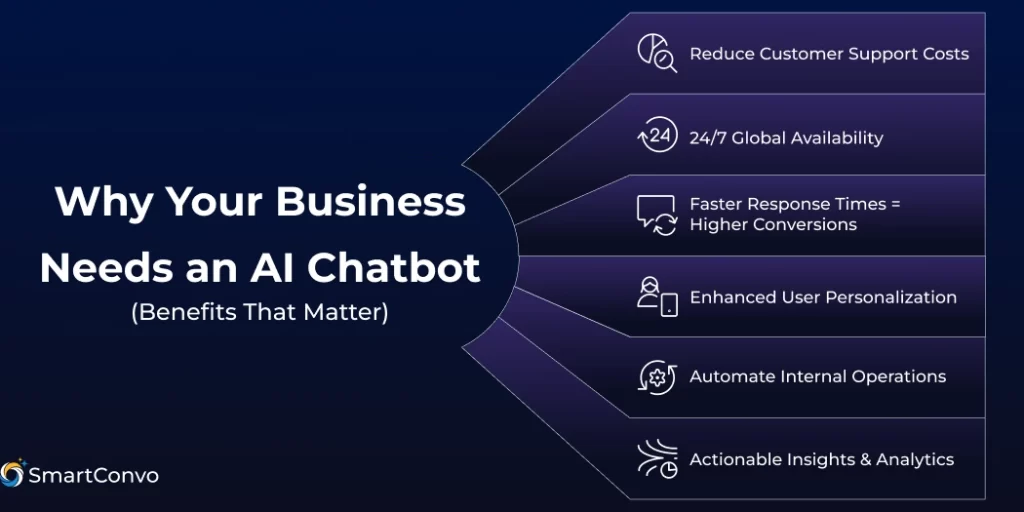
Let’s get practical. Why are startups and growth-stage companies embracing AI chatbots? Here are key benefits across operational, financial, and strategic domains:
1. Reduce Customer Support Costs
Automating repetitive queries (like order status, refunds, or onboarding) reduces support costs by up to 30–40%.
2. 24/7 Global Availability
Whether it’s 3 AM in New York or 9 AM in Mumbai, your bot works round-the-clock—ideal for global SaaS or eCommerce startups.
3. Faster Response Times = Higher Conversions
Whether in sales or support, speed = trust. AI Chatbots can respond in milliseconds, guiding users through funnels instantly.
No Credit Card Required | 14 days Free Trial
Build Your Chatbot
4. Enhanced User Personalization
With LLM-based intelligence, bots can tailor product recommendations, reminders, and messages based on user behavior and preferences.
5. Automate Internal Operations
Startups use AI chatbots to automate:
- HR onboarding
- IT helpdesk tasks
- Internal documentation queries
- Workflow status updates
6. Actionable Insights & Analytics
Every interaction becomes a data point—enabling founders and CTOs to understand:
- What users are asking
- Where they drop off
- What objections are common in the buyer journey
How AI chatbots are used across businesses
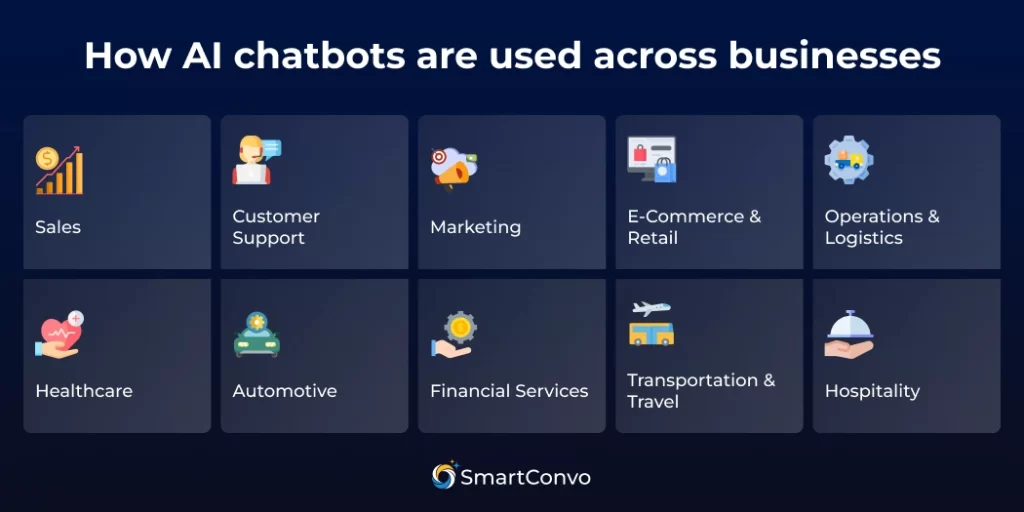
Let’s break down where AI chatbots are actively driving ROI:
Sales
AI chatbots help sales teams increase ROI by automating repetitive interactions and focusing reps on high-value conversations.
- Qualify leads in real-time through the website or WhatsApp chat
- Answer product or pricing questions 24/7
- Book meetings directly to sales calendars
- Route leads based on priority using CRM integration
- Nurture prospects with conversational drip campaigns
Customer Support
Customer support teams benefit significantly from AI chatbots by automating common queries and improving resolution times.
- Deflect up to 80% of Level 1 support tickets
- Provide instant answers from the knowledge base
- Escalate unresolved issues to live agents seamlessly
- Collect and analyze CSAT feedback after each interaction
- Enable 24/7 global support without growing the team
Marketing
AI chatbots are powerful marketing assistants that help in audience engagement, campaign automation, and data collection.
- Conduct lead-generating surveys and quizzes
- Engage users with interactive conversational landing pages
- Run WhatsApp or Messenger-based ad campaigns
- Automate gated content delivery (eBooks, webinars)
- Personalize messages based on user behavior or segments
E-commerce & Retail
In the commerce world, chatbots serve as intelligent shopping assistants that boost conversions and customer satisfaction.
- Recommend products based on user behavior or purchase history
- Assist with cart recovery and abandoned checkout reminders
- Manage order tracking, returns, and shipping status
- Detect fraud patterns and flag suspicious orders
- Offer real-time promotions or upsell/cross-sell suggestions
Operations & Logistics
Chatbots can streamline backend processes by handling internal workflows and supporting employee operations.
- Automate internal ticket management (IT, HR, Facilities)
- Provide instant access to SOPs, policy documents, and onboarding FAQs
- Manage inventory queries and dispatch updates via chat
- Support supplier/vendor coordination through bot interactions
Healthcare
In healthcare, AI chatbots assist in patient engagement, support staff, and improve operational efficiency — all while complying with privacy regulations.
- Triage symptoms and suggest next steps
- Help patients schedule, reschedule, or cancel appointments
- Offer 24/7 mental health or general health support
- Assist in insurance claims or document verification
- Guide users through prescription refills and treatment plans
Automotive
Automotive companies use chatbots to enhance customer experience and streamline service processes.
- Handle inquiries about vehicle specs or financing
- Book test drives or service appointments
- Assist with vehicle troubleshooting and diagnostics
- Notify users of service schedules or insurance renewals
Financial Services
AI chatbots in finance are built to support both customer-facing and compliance-focused workflows.
- Help users with account details, balance checks, and transaction history
- Deliver personalized financial advice based on spending behavior
- Detect fraudulent activity and trigger alerts
- Simplify KYC processes and identity verification
- Support investment-related queries in real time
Transportation & Travel
Chatbots improve customer experience across the travel and transportation journey, from planning to arrival.
- Manage bookings and cancellations
- Provide real-time updates on flight, train, or bus schedules
- Share personalized travel itineraries
- Handle refund requests and documentation
- Assist with lost luggage queries or check-in processes
Hospitality
From booking to room service, AI chatbots are transforming the hospitality industry into a more personalized and frictionless experience.
- Enable contactless check-ins and check-outs
- Offer custom recommendations for rooms, dining, and experiences
- Respond to room service or housekeeping requests instantly
- Predict when rooms need cleaning or restocking based on guest data
- Collect guest feedback to optimize the experience
Final Thoughts
As a startup founder or CTO, embracing AI chatbots is not just about saving time—it’s about building scalable infrastructure that delights customers and drives growth.
They’re more than support agents. They’re digital brand ambassadors, sales reps, onboarding assistants, and internal automation engines.
The future of business is conversational. The smartest startups are already building with AI chatbots—don’t get left behind.
Frequently Asked Questions (FAQ)
Yes, most enterprise-grade bots offer encryption, GDPR compliance, and audit trails. Always check vendor compliance details.
It can take as little as 10 minutes for basic bots and 1-2 weeks for complex integrations.
Absolutely. Multilingual support is now standard with most LLM-based platforms.
You can upload FAQs, documents, or use APIs. Some tools allow training via conversation flows or customer interactions.
No. They act as assistants, handling repetitive tasks so your team can focus on complex, strategic work.

With 8+ years of experience as a software engineer in the IT field, an Elite in Back-end development, DevOps, and Project & Team Management. Read more