
AI Chatbot vs IVR: What’s Better for Customer Experience?

Written By : Shantilal Matariya

Published on : July 24, 2025

8 min read


Tired of pressing “1 for sales” and “2 for support,” only to wait on hold? Or maybe you’ve had a smooth chat with an AI sales assistant that solved your problem in seconds?
These are two common tools businesses use to support their customers:
IVR (Interactive Voice Response) and AI Chatbots.
Both can save time and reduce the need for live agents—but they offer very different experiences.
In today’s digital world, customers expect fast, easy, and personalized support. That’s why more businesses are asking: AI Chatbot vs IVR — which one improves customer experience?
In this blog, we’ll break down the definition, key differences between IVR and AI chatbots, their pros and cons, and how each impacts your customers.
By the end, you’ll know exactly which tool fits your business and keeps your customers happy.
What is an IVR system?
If you’re wondering, “What does IVRS stand for?” It means Interactive Voice Response System. The “system” is added for clarity. These systems have been used in customer service since the 1970s, starting with simple menus and evolving into advanced platforms with voice recognition.
An Interactive Voice Response (IVR) system is a technology that allows customers to interact with a computer through voice commands or keypad inputs. You’ve probably experienced it when you call a business and hear something like, “Press 1 for sales, press 2 for support.” That’s an IVR system in action.
How Does an IVR System Work?
IVR systems guide callers through preprogrammed menus using either:
- Keypad inputs (Dual-Tone Multi-Frequency or DTMF signals)
- Voice commands (Automatic Speech Recognition, or ASR, technology)
Based on your choices, the system can route your call to the right department, answer basic questions, or even handle tasks like bill payments or scheduling appointments.
What is an AI chatbot?
An AI chatbot is a tool that uses artificial intelligence to have conversations with people. It works through text or voice and is designed to feel human-like.
Unlike basic chatbots that follow strict rules, AI chatbots can understand what you’re saying, learn from past chats, and give smarter, more helpful answers.
How Do AI Chatbots Work?
AI chatbots use advanced technology like natural language processing (NLP) and machine learning to figure out what users mean—even if the question is phrased differently, contains slang, or has typos.
They’re smart enough to handle conversations across multiple platforms, such as:
– Websites
– Mobile apps
– Social media
– Messaging apps
AI chatbots aren’t just a smarter way to chat—they’re transforming how businesses provide customer support, saving time while keeping customers happy.
AI Chatbot vs IVR: Understanding the Key Differences
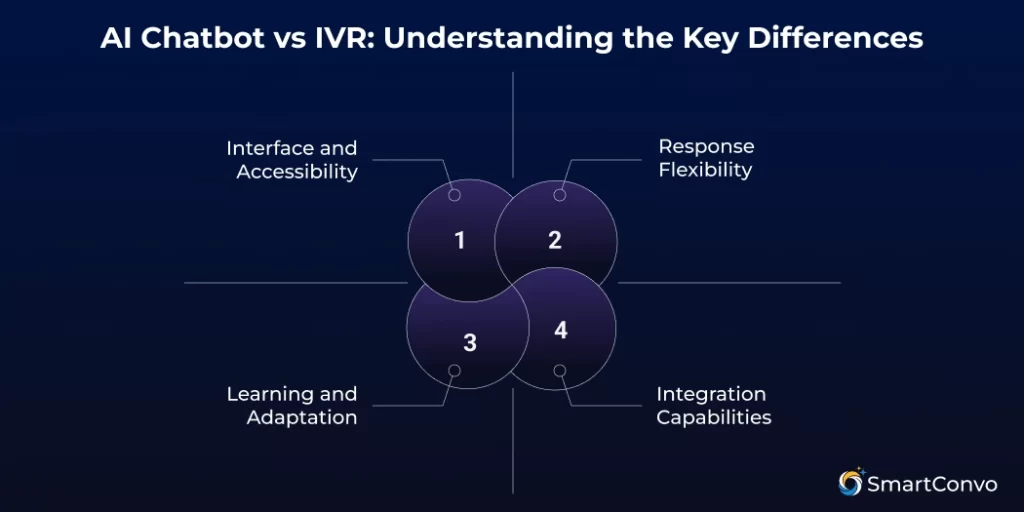
The main difference between IVR and chatbots is how they interact with users. IVR uses structured menus to guide customers step by step, while chatbots are more advanced and have flexible, conversational interactions that adapt to different communication styles.
Interface and Accessibility
- IVR systems rely on voice-only interactions, where customers call a number and follow audio prompts. This can be difficult for people with hearing impairments or in noisy places.
- AI chatbots work mostly through text on digital platforms, making them more accessible. Voice-enabled chatbots are also becoming more common.
Response Flexibility
Comparing AI chatbots vs IVR shows big differences in how they respond to users.
- IVR systems stick to fixed scripts and can only play prerecorded messages or send calls to specific places.
- AI chatbots can respond in real-time, understand the situation, and have more natural, human-like conversations with customers.
Learning and Adaptation
IVR systems need manual updates to add new features or change menus, which can take a lot of time and money.
AI chatbots learn and improve automatically from conversations, so they get better and smarter without needing constant updates.
Integration Capabilities
Both technologies can work with business systems, but AI chatbots connect more easily with modern tools like digital platforms, CRMs, and multi-channel support.
AI Chatbot vs IVR: Pros and Cons for Customer Experience
Here’s a simple look at the pros and cons of AI chatbots vs IVR systems to show how they impact customer experience.
Pros of IVR System
- Works with any standard phone line
- Simple and familiar for customers used to regular phone systems
- Great for basic, everyday tasks
- Lower setup costs for basic systems
- Reliable and uses proven technology
Cons of IVR System
- Struggles with complex questions
- Complicated menus can frustrate customers and make them leave.
- Hard to support customers with disabilities
- Expensive to run phone-based support
- Can’t share visual info or documents
Pros of AI Chatbot
- Available 24/7 across multiple digital channels
- Understands complex questions and gives clear answers
- Responds instantly, no waiting required
- Lets you share images, documents, and links
- Handles multiple chats at the same time with ease
- Gets smarter over time with machine learning learning
Cons of AI Chatbot
- May have trouble handling very complex or emotional situations
- Needs regular updates and training
- It can be hard to use for non-native speakers.
- Some customers prefer talking to a real person for sensitive issues.
- Setting up advanced features can be complicated.
AI Chatbot vs IVR: Impact on Customer Experience

The impact of IVR vs chatbot solutions on customer experience depends on how well they’re implemented and who the customers are.
Studies show that more people now prefer digital interactions. Messaging and chat platforms often make customers happier than phone support, especially for simple questions.
Using a chatbot for customer service in these situations can improve response time and overall satisfaction.
Response Time and Efficiency
- AI chatbots are great at giving instant replies, saving customers from long wait times and making things easier.
- IVR systems are faster than waiting for a live agent but can still be frustrating. Customers often have to go through multiple menu options, which can make solving complex issues take longer.
Personalisation Capabilities
- Modern AI chatbots use customer history, preferences, and past interactions to offer personalized support.
- IVR systems, on the other hand, provide less personalization since they rely only on voice interactions.
Customer Satisfaction Metrics
Studies show that chatbots can make customers happier than traditional phone systems, especially younger people who like texting. However, some customers still prefer phone systems if they’re not comfortable with digital tools.
When to Use AI Chatbots vs IVR
Choose IVR Systems When:
- Your customers mostly prefer to communicate over the phone.
- You handle many simple tasks like bill payments or scheduling appointments.
- Regulations require you to offer phone support.
- Your business is in areas with limited internet access.
- You already have phone systems and want to improve them step by step.
Choose AI Chatbots When:
- Your customers prefer online interactions.
- You need to support customers across different channels and time zones.
- Your support often involves sharing visuals or documents.
- You want to lower costs without sacrificing service quality.
- Engaging with customers proactively helps your business grow.
Hybrid Approach:
Successful businesses combine both AI chatbots and IVR systems. Chatbots handle simple questions and first contact, while IVR provides phone support or connects customers to a human for more complex issues.
How to Choose the Right Solution for Your Business
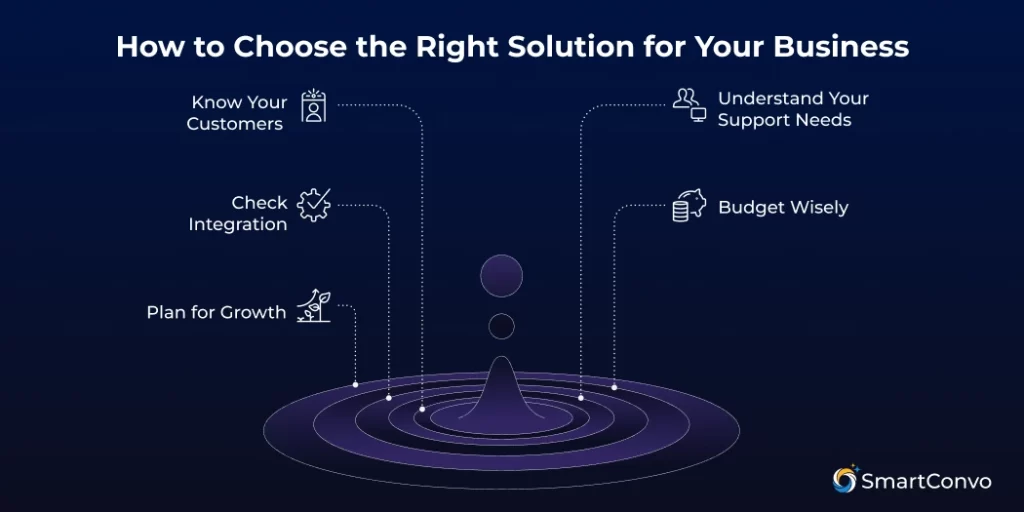
Choosing between AI chatbots and IVR systems? Here’s what to consider:
Know Your Customers
Understand your customers’ preferences and how they like to communicate. Use surveys or review current support channels to see what works best for them.
Understand Your Support Needs
Think about the types of questions your customers ask. For simple, quick answers, both options work well. For more complex issues, AI chatbots are more flexible.
Check Integration
Make sure the solution fits with your existing tools like CRM systems or knowledge bases. If you serve a diverse audience, consider if you need a multilingual chatbot.
Budget Wisely
Look at both setup costs and ongoing expenses. IVR systems may be cheaper upfront, but AI chatbots often save money in the long run and keep customers happier.
Plan for Growth
If your business is growing, choose a solution that can grow with you. AI chatbots are usually better for handling increasing customer demands.
Conclusion
Choosing between AI chatbot vs IVR systems depends on your business needs and customer preferences. Both technologies have their strengths, but the best approach often combines them for a seamless customer experience.
SmartConvo makes this easy by integrating AI chatbots and IVR, helping you boost customer satisfaction and streamline operations. Start with a pilot program, gather feedback, and fine-tune your setup to get the best results.
Remember, success comes from proper implementation and ongoing optimization. With tools like SmartConvo, you can deliver efficient, customer-first service tailored to your goals.
Frequently Asked Questions (FAQ)
AI chatbots offer quicker replies by handling multiple queries instantly without long phone menus.
Yes, chatbots reduce support costs by automating tasks and scaling easily across digital channels.
Not fully—IVR is still useful for voice calls; many businesses combine both for better support.
AI chatbots usually provide faster, more personalized support, leading to higher satisfaction.

With 8+ years of experience as a software engineer in the IT field, an Elite in Back-end development, DevOps, and Project & Team Management. Read more