
AI Chatbots vs Human Agents: Who Delivers Better CX?

Written By : Shantilal Matariya

Published on : August 25, 2025

9 min read


Customer expectations have changed dramatically in recent years. Today, people want instant replies, round-the-clock availability, and personalized solutions without being stuck in long wait loops. Meeting these demands with only human agents is difficult—costs rise quickly, burnout becomes real, and churn quietly eats into growth.
That’s why many businesses now face a big decision: should they rely on AI chatbots vs human agents, or a mix of both? This debate goes beyond cost-saving—it’s about building customer support that truly delivers a seamless customer experience.
Modern AI chatbots are smarter than ever, capable of handling routine queries, integrating with business systems, and reducing churn by offering instant support. Meanwhile, human agents vs AI chatbots bring different strengths: empathy, problem-solving, and trust that technology still struggles to match.
In this blog, we’ll look at the pros and cons of both, explore the difference between AI Chatbots vs Human Agents, and answer the key question: Is it really AI vs humans, or is the best approach a smart combination of both?
What are AI Chatbots & Human Agents?
Before we compare, let’s quickly explain the two approaches.
An AI Chatbot is a smart software program that uses artificial intelligence to have conversations with people. It can understand questions, give helpful answers, and even learn to improve over time. Unlike basic chatbots, modern AI chatbots can handle complex chats, connect with your Knowledge Base, and offer support based on customer history.
Human agents are real people who talk to customers through phone, email, chat, or social media. They bring emotional intelligence, creativity, and flexibility to handle unique situations. They can understand emotions, show empathy, and make decisions based on context and nuance.
As businesses scale, knowing the difference between AI Chatbots vs Human Agents becomes crucial. While AI chatbots provide efficiency and 24/7 coverage, human agents can turn negative experiences into loyal relationships through genuine care.
Pros and Cons of AI Chatbots
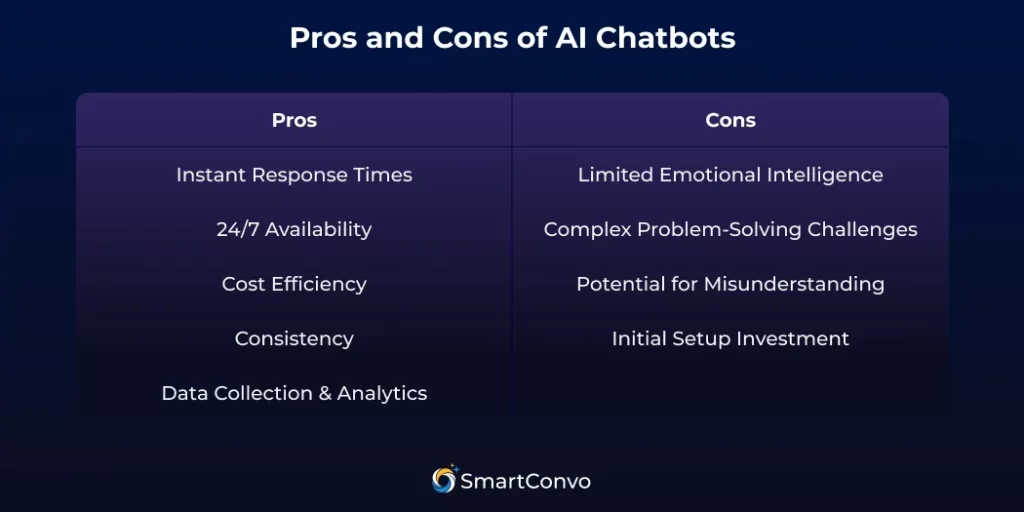
AI Chatbot technology has evolved remarkably, offering businesses powerful tools to enhance their customer experience. Let’s examine both the advantages and limitations of this approach.
Pros of AI Chatbots
Instant Responses: AI chatbots reply to customer questions in seconds, cutting out frustrating wait times. This quick response is especially helpful for simple questions or common issues.
24/7 Support: Unlike AI chatbots vs human support, bots never sleep, ensuring customers worldwide get help anytime. This is great for global customers in different time zones or for urgent issues outside normal hours.
Cost-Effective: Once set up, AI chatbots can handle thousands of chats at once without extra staff costs. This makes them an affordable option for managing high volumes of routine questions.
Consistency: AI chatbots provide the same quality service to every customer. They don’t have off days and deliver responses based on their programming, ensuring consistent experiences.
Data and Insights: AI chatbots collect and analyze data from interactions. They can spot common problems, track customer satisfaction, and provide insights to improve service quality.
Cons of AI Chatbots
Limited Emotional Intelligence: AI has come a long way, but chatbots still have trouble understanding emotions. They can’t really feel empathy or give the emotional support needed in tough situations.
Complex Problem-Solving Challenges: AI chatbots are great for simple or common problems, but they can struggle with unique or complex issues. They work well with clear rules, but aren’t as good when creative solutions are needed.
Potential for Misunderstanding: Natural language processing is smart but not flawless. Chatbots can misunderstand what customers mean, especially when dealing with sarcasm, slang, or complicated sentences, which can make conversations frustrating.
Initial Setup Investment: Setting up an AI Agent system can be expensive at first, as it needs the right technology, training, and setup. However, these costs usually pay off in the long run.
Pros and Cons of Human Agents
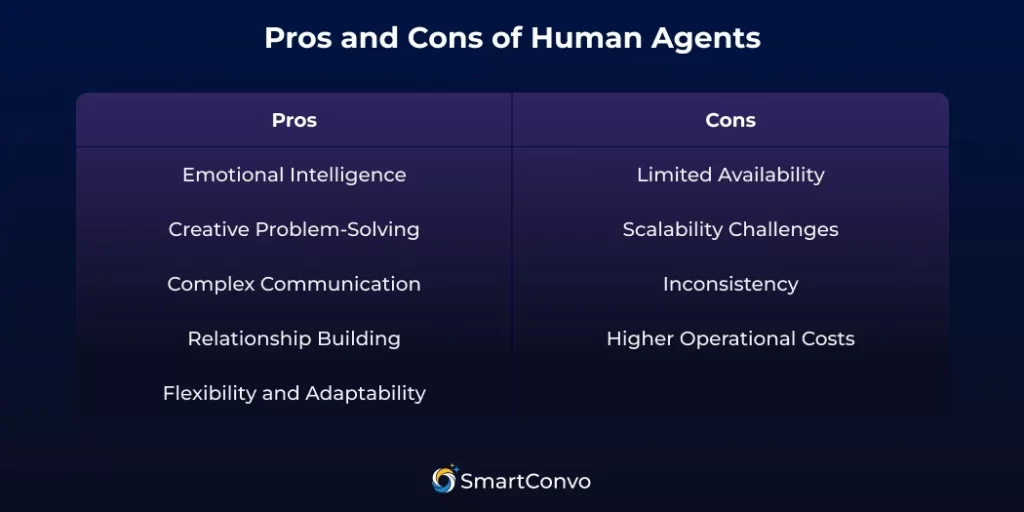
Human agents bring a completely different set of strengths and challenges to customer support operations. Let’s explore what makes them irreplaceable in certain situations and where they might fall short.
Pros of Human Agents
Emotional Intelligence: Human agents can understand and respond to customer feelings. They can calm upset customers, share in their successes, and offer support to build strong relationships.
Creative Problem-Solving: Human agents can handle unique situations by thinking creatively. They can mix solutions, make exceptions when needed, and solve problems that don’t follow the usual rules.
Complex Communication: Humans are great at understanding context, picking up on hidden meanings, and interpreting tone or non-verbal cues in conversations. They can handle complex discussions that need clarification and flexibility.
Relationship Building: Experienced human agents can connect with customers, building trust and loyalty. They remember past interactions and offer personalized service that makes customers feel appreciated.
Flexibility and Adaptability: Human agents can adjust how they communicate to fit what customers prefer, try different methods if one isn’t working, and manage surprises calmly.
Cons of Human Agents
Limited Availability: Human agents can’t work all the time—they need breaks and work in shifts. Limited availability compared to AI chatbots vs humans in customer service, who expect 24/7 help.
Scalability Challenges: Hiring and training people takes a lot of time and effort. It can also be hard and costly to quickly add more staff during busy times or periods of growth. That’s where flexible staffing solutions can make all the difference.
Inconsistency: People’s performance changes based on things like experience, training, mood, and personal situations. This can cause customer experiences to be different each time.
Higher Operational Costs: Human agents require salaries, benefits, training, management, and workspace resources. These ongoing costs can be significant, especially for businesses handling high volumes of support requests.
The Difference Between AI Chatbots vs Human Agents
It’s important to know the differences between AI chatbots and human agents to choose the right customer support strategy.
Here’s a simple breakdown of what sets them apart in real-world use. Understanding the difference between AI Chatbots vs Human Agents is vital for shaping customer support strategies.
| Aspect | AI Chatbots | Human Agents |
|---|---|---|
| Response Time | Provide instant replies within seconds | May take longer depending on workload and queue |
| Availability | Accessible 24/7 across time zones | Limited to business hours or shift schedules |
| Scalability | Can manage thousands of queries simultaneously | Can only handle one customer at a time |
| Cost Efficiency | Lower long-term costs with minimal manpower | Higher costs due to salaries, training, and turnover |
| Accuracy | Delivers consistent answers based on training | Can vary depending on knowledge, mood, or stress |
| Personalization | Offers data-driven personalization but lacks empathy | Builds genuine emotional connections and trust |
| Problem Solving | Effective for FAQs and straightforward queries | Strong at resolving complex, sensitive, or unique issues |
| Customer Satisfaction | Satisfies customers who value speed and convenience | Satisfies customers who value empathy and human touch |
Many companies now combine these strengths by deploying an AI Chatbot for Customer Service to handle quick responses, while human agents step in for cases requiring empathy and trust.
Can AI Chatbots Actually Reduce Churn?
AI chatbots can reduce customer churn when implemented effectively. Done right, they enhance customer experience by quickly solving common problems. Chatbots provide instant answers, resolve routine issues, and are available 24/7, reducing frustration and preventing small problems from escalating.
Chatbots can also analyze customer interactions to spot signs of dissatisfaction early. Tools like SmartConvo use this data to identify at-risk customers, allowing businesses to take action before they leave.
Poorly designed chatbots can backfire. If customers get stuck in unhelpful loops or their needs aren’t met, frustration grows, and they may leave. That’s why chatbots should handle simple tasks efficiently while offering an option to connect with human agents.
The best approach blends chatbot efficiency with human empathy. Chatbots handle common issues and flag complex ones, while human agents provide personalized support. This balance keeps customers happy and reduces churn.
How AI Chatbots Actually Reduce Churn?
- AI chatbots reduce churn by delivering quick, reliable, and consistent customer experiences.
- Available 24/7, they provide instant responses to common queries, avoiding long wait times.
- Chatbots analyze customer interactions in real time to identify dissatisfaction and escalate issues to human agents.
- They offer personalized recommendations and solutions based on customer data for a tailored experience.
- With platforms like SmartConvo, businesses can implement AI chatbots effectively to streamline support, build trust, and foster long-term customer loyalty.
AI Chatbot vs Human Agents: Which One Should You Choose?
Making the right choice between AI chatbots and human agents isn’t about picking one over the other—it’s about understanding how to use each approach where it provides the most value. The best customer experience strategies combine both technologies strategically.
The choice between human agents vs AI chatbots isn’t about one replacing the other. Instead, businesses should strategically combine both.
Choose AI Chatbots When:
- Your customers often ask the same questions with simple answers
- You need support available 24/7 without high staffing costs
- You’re handling a lot of basic inquiries
- You want to track and analyze customer interactions
- Your customers like self-service options
- You need to scale support quickly without spending more
Choose Human Agents When:
- Customers are dealing with complex or emotional issues
- The situation requires creative problem-solving or rule exceptions
- You’re serving high-value customers who expect premium service
- The interaction involves sensitive topics that require empathy
- You need to build long-term customer relationships
- The issue requires extensive back-and-forth communication
Conclusion
AI chatbots vs human agents is not simply about deciding who performs better—it’s about shaping a support system that truly works for your customers. Chatbots excel at handling speed, scale, and consistency, while humans bring empathy, creativity, and judgment to situations where a personal touch matters most.
The best businesses balance AI and human support. AI handles routine queries and reduces wait times, while human agents focus on complex cases. The true power lies in integration: AI chatbots vs human support should work together, not compete.
With solutions like SmartConvo, you can strike this perfect balance—leveraging the efficiency of an AI Chatbot for Customer Support without losing the human touch. The real competitive advantage lies in integrating both seamlessly to deliver exceptional CX, but how can you integrate both to create faster, more personalized, and memorable customer experiences?
Frequently Asked Questions (FAQ)
Chatbots give fast automated replies, while humans bring empathy and creative solutions.
Yes, chatbots cut churn with instant support, consistency, and timely issue escalation.
Use chatbots for FAQs and 24/7 help, while humans solve complex or emotional issues.
Humans build trust with empathy, while chatbots scale fast but lack emotional depth.
Chatbots work 24/7 with instant replies, humans take longer but give personalized care.

With 8+ years of experience as a software engineer in the IT field, an Elite in Back-end development, DevOps, and Project & Team Management. Read more