
The ROI of AI Chatbots in Customer Service: Is It Worth It?

Written By : Shantilal Matariya

Published on : August 26, 2025

9 min read


When businesses consider adopting new technology, the first question that often comes up is: What’s the return on investment (ROI)? The same applies to AI chatbots in customer service. While AI is one of today’s hottest topics, smart decisions depend on measurable results—not just hype.
Customer service has always been costly, needing large teams to handle inquiries. AI chatbots are changing that. Unlike older bots, modern ones understand context, personalize responses, and solve issues in real time. They’re available 24/7, handle thousands of chats at once, and let human agents focus on more important tasks.
Still, the big question remains: What is the ROI of AI chatbots in customer service? Is it worth it? In this blog, we’ll break down AI chatbot ROI, covering cost savings, revenue opportunities, and customer experience benefits, with real-world examples—helping you decide if an AI chatbot is right for your business.
What is AI Chatbot ROI?
AI Chatbot ROI (Return on Investment) shows how profitable it is to use an AI chatbot. It compares the money saved or earned by the chatbot to how much it costs. A positive ROI means the chatbot brings more value than it costs, while a negative ROI means it’s not worth the investment.
Calculating ROI isn’t always simple. It includes direct savings, like spending less on customer support, and indirect benefits, like happier and more loyal customers. The idea is simple: if the chatbot saves or earns more than it costs, it’s a good investment.
ROI = (Net Profit from Chatbot / Total Cost of Chatbot) x 100
However, identifying all the variables that contribute to “Net Profit” and “Total Cost” is the crucial part.
Costs to Consider:
- Subscription Fees: Monthly or yearly licensing costs for the chatbot platform.
- Setup Costs: Initial expenses for integrating with systems like CRMs and helpdesks.
- Training: Costs for training the AI with your data and creating conversation flows.
- Maintenance: Ongoing expenses for updates and optimization.
Gains to Measure:
- Reduced Costs: Savings from handling inquiries without needing a human agent.
- Boosted Productivity: Time saved lets agents focus on complex tasks.
- Revenue Growth: Sales or leads generated through chatbot interactions.
- Better Retention: Value from keeping customers who might have left due to poor service.
Understanding these components is the first step toward accurately assessing the ROI of AI chatbots and making an informed decision for your business.
How AI Chatbots Deliver ROI in Customer Service
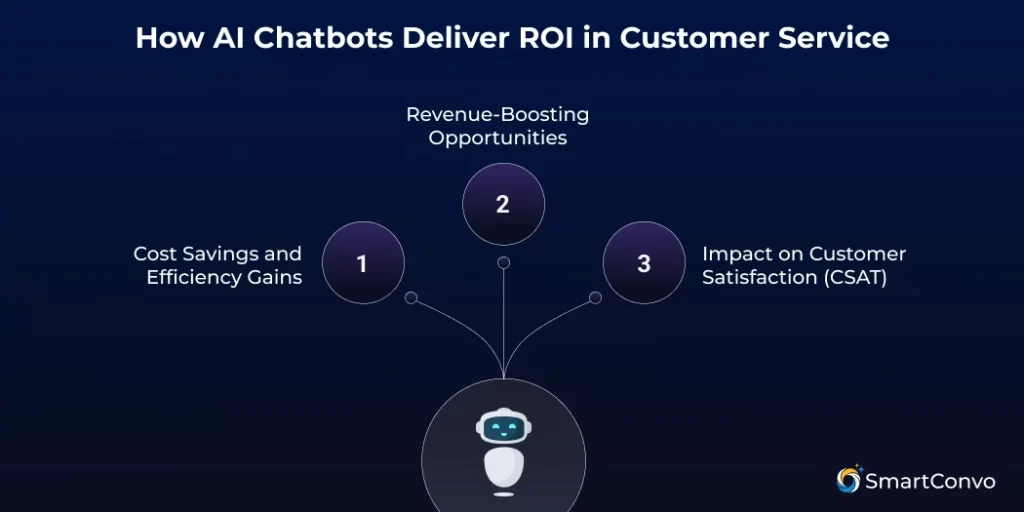
AI chatbots in customer service don’t just save money—they also make things run smoother, bring in more revenue, and improve the overall customer experience. Let’s explore the key areas where a platform like SmartConvo can deliver a significant return.
Cost Savings and Efficiency Gains
This is often the most immediate and measurable component of AI Chatbot ROI. By automating repetitive and high-volume inquiries, chatbots directly reduce the operational costs associated with a traditional customer service center.
- Ticket Deflection: Chatbots instantly handle common questions like “Where is my order?” or “How do I reset my password?” without needing a human agent. With each deflected ticket saving $5-$15, deflecting thousands monthly can save significant costs.
- 24/7 Availability: Chatbots provide support around the clock, eliminating the need to hire overnight staff. They work nonstop, ensuring customers get answers anytime, reducing the need for costly after-hours support teams.
- Reduced Training Time: Human agents need extensive training, but a chatbot becomes an expert as soon as it’s set up with a good knowledge base. This saves time and money on onboarding and ensures consistent, accurate information is always available.
- Increased Agent Capacity: Chatbots handle simple questions, letting human agents focus on complex issues. This improves support for critical interactions and boosts efficiency. An agent who handled 50 simple tickets can now resolve 15 complex issues, adding greater value.
Revenue-Boosting Opportunities
An effective AI chatbot for customer service cuts costs and drives revenue. By engaging customers at crucial moments, chatbots can boost sales and improve customer lifetime value, fueling business growth.
- Proactive Lead Generation: Chatbots engage website visitors, ask questions, and collect contact details. Instead of waiting for a “Contact Us” form, they take the initiative to turn visitors into qualified leads for your sales team.
- Upselling and Cross-selling: Chatbots can suggest additional or better products during a support chat. For example, if a customer asks about a product, the bot might recommend a matching accessory or a premium upgrade, increasing the order value.
- Reduced Cart Abandonment: E-commerce chatbots can stop users from leaving the checkout page by offering a small discount, answering last-minute questions, or providing reassurance. This can encourage customers to complete their purchase.
- Personalized Recommendations: By looking at a user’s browsing history and past purchases, chatbots can suggest products tailored to their preferences, creating a more personal shopping experience that boosts sales and builds loyalty.
Impact on Customer Satisfaction (CSAT)
Customer satisfaction is key to long-term success. Happy customers are more likely to buy again, recommend your brand, and stay loyal, all of which can boost your profits.
- Instantaneous Responses: In today’s fast-paced world, no one likes to wait. AI chatbots give instant answers, cutting out hold times and delays. This makes customers happier and improves satisfaction scores.
- Consistent and Accurate Information: Chatbots don’t have bad days like humans do. They always give accurate, consistent information from your approved knowledge base. This helps build trust in your brand.
- Seamless Handoffs: If a problem needs a human touch, an AI chatbot for customer support can gather all the necessary details first and pass the full conversation to a live agent. This helps customers avoid repeating themselves, simplifying the process.
Data-Driven Improvements: Chatbots collect a lot of useful customer information, like questions, concerns, and feedback. By analyzing this data, you can learn about customer problems, improve your products, and fix gaps in your help resources. This helps make the customer experience better over time.
Real-World Examples of ROI with AI Chatbots
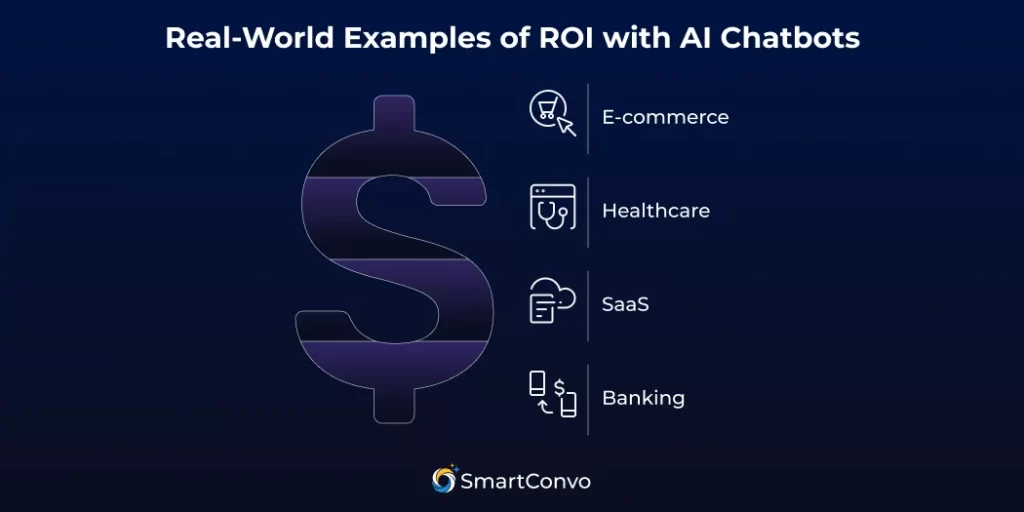
AI sounds great in theory, but its real value comes from how it’s used in the real world. Companies in many industries are using chatbots to tackle problems and see big results.
E-commerce
An online fashion retailer implemented a chatbot to handle the high volume of queries about order status, returns, and sizing.
- Result: They reduced live chat inquiries on these topics by 65% in three months, allowing the support team to focus on personalized styling advice. This led to a 15% increase in average order value for customers who interacted with a human agent. The ROI of AI chatbots came from both cost savings and revenue growth.
Healthcare
A large hospital network deployed a chatbot to help patients schedule appointments, refill prescriptions, and find information about services.
- Result: The chatbot successfully handled 40% of all incoming patient requests, freeing up administrative staff to manage more complex patient cases and in-person check-ins. Patient satisfaction scores related to appointment scheduling increased by 25% due to the 24/7 convenience.
SaaS
A B2B software company integrated a chatbot into its help center to provide instant technical support for common issues.
- Result: The chatbot resolved 30% of technical support tickets automatically by guiding users to relevant articles in the knowledge base, helping to reduce support ticket volume. This cut the first-response time for complex tickets from four hours to under one, boosting customer retention and reducing churn by 5% in the first year.
Banking
A national bank launched a chatbot to assist customers with balance inquiries, transaction history, and reporting lost cards.
- Result: Calls to their contact center dropped by 20%, saving the bank over $1 million a year. The chatbot also helped users learn about saving and budgeting, boosting customer engagement, and improving how people view the brand.
Strategies to Maximize AI Chatbot ROI
Deploying an AI chatbot isn’t a “set it and forget it” process. To get the best results, you need a clear strategy and regular updates. Here’s how:
- Set Clear Goals: Decide what you want to achieve. Are you trying to lower support costs, boost lead conversions, or improve customer satisfaction (CSAT)? Clear, measurable goals help guide your strategy and track progress.
- Use a Strong Knowledge Base: Your chatbot is only as smart as the information it has. Make sure it’s connected to an up-to-date and detailed knowledge base so it can provide accurate answers.
- Focus on the Right Tasks: Don’t try to automate everything at once. Start with simple, high-volume tasks—like common customer questions—that are quick to address. Use support ticket data to identify these.
- Promote It: Let your customers know about the chatbot. Highlight its 24/7 availability and speed on your website, app, or emails to encourage them to use it.
- Review and Improve: Regularly check how the chatbot is performing. Look at conversation logs to find areas where it struggles or questions it can’t answer. Use this feedback to improve its responses and add new information.
- Plan for Human Handoff: Chatbots don’t replace human agents—they support them. Make sure there’s a smooth process for handing off conversations to agents when needed, so customers don’t lose context or face delays.
Conclusion: Is it Worth It?
AI chatbots can completely transform customer service when used strategically, offering amazing returns on investment. They are no longer just a future technology or a simple tool to cut costs—they’re powerful assets that improve efficiency, boost revenue, and strengthen customer relationships.
Chatbots don’t just automate tasks—they generate leads, upsell, and deliver the fast, high-quality service customers expect. This frees human agents to focus on complex or emotional issues, acting as true brand ambassadors.
While there are upfront costs to implement AI chatbots, understanding AI chatbot pricing is key to weighing the investment. The long-term benefits—time saved, higher sales, and stronger loyalty—make it worth it. For any business aiming to grow and improve service, investing in AI chatbots is only a matter of when.
Frequently Asked Questions (FAQ)
It’s the value businesses gain from chatbots through cost savings, efficiency, and customer satisfaction.
They automate FAQs, reduce agent workload, and lower staffing needs, saving money for businesses.
Yes, they provide 24/7 instant responses, reduce wait times, and offer consistent, helpful support.
E-commerce, healthcare, finance, hospitality, and education see the highest returns from chatbot use.
Yes, pre-built chatbots are affordable, quick to deploy, and help small firms save time and money.

With 8+ years of experience as a software engineer in the IT field, an Elite in Back-end development, DevOps, and Project & Team Management. Read more